
rushdb
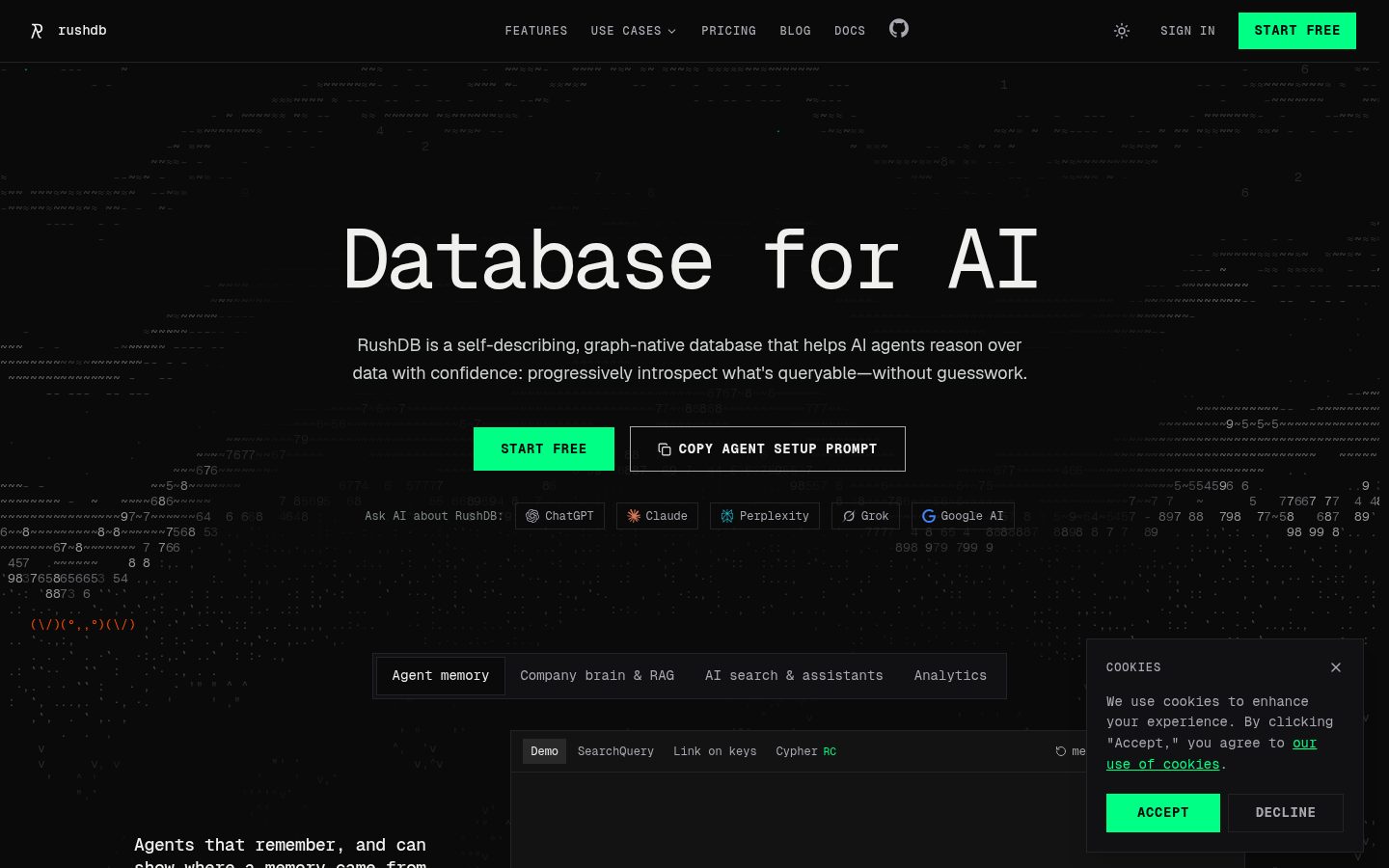
RushDB is a self-describing, graph-native database that helps AI agents reason over data with confidence: progressively introspect what's queryable—without guesswork.
Automatically checked · GitHub checked 2026-11-13
Overview

RushDB — the database for AI
One database for your records, their relationships, and search over them.
Write JSON. RushDB infers the types, links nested objects into a graph, and lets you query it with its JSON query language, SQL, Cypher, Gremlin or Mongo-style documents, plus vector, full-text and hybrid search. One Rust binary, one data directory, Apache-2.0.



Website • Documentation • Manual • RushDB Cloud • Deploy
English • 中文 • 日本語 • 한국어 • Deutsch • Français • Português • Español • हिन्दी • العربية • Bahasa Indonesia • ไทย
Quick start
curl -fsSL https://raw.githubusercontent.com/rush-db/rushdb/main/install.sh | sh
rushdb up
The script installs the rushdb binary into ~/.rushdb/bin after checking
the release checksum (and its Sigstore signature when cosign is installed).
rushdb up starts a durable node on http://127.0.0.1:3000 with its data in
./.rushdb and the local token local-token.
Write a nested JSON document. Every nested object becomes its own record, linked to its parent:
export RUSHDB_TOKEN=local-token
curl -s http://127.0.0.1:3000/protocol/v1/execute \
  -H "Authorization: Bearer $RUSHDB_TOKEN" -H 'Content-Type: application/json' \
  -d '{"protocolVersion":1,"operation":{"kind":"ingest","ingest":{"kind":"documents","label":"COMPANY",
       "documents":{"name":"Acme","DEPARTMENT":[
         {"name":"Engineering","headcount":12,"EMPLOYEE":[{"name":"Ada","role":"Staff Engineer"},{"name":"Linus","role":"Engineer"}]},
         {"name":"Sales","headcount":4,"EMPLOYEE":[{"name":"Grace","role":"Account Executive"}]}]}}}}'
Then find the engineers at Acme. The filter reaches across relationships by naming the related labels:
curl -s http://127.0.0.1:3000/protocol/v1/execute \
  -H "Authorization: Bearer $RUSHDB_TOKEN" -H 'Content-Type: application/json' \
  -d '{"protocolVersion":1,"operation":{"kind":"query","query":{"kind":"records","query":{
       "labels":["EMPLOYEE"],
       "predicate":{"role":{"$contains":"Engineer"},"DEPARTMENT":{"COMPANY":{"name":"Acme"}}}}}}}'
Continue with the Quickstart.
Query it your way
The same records answer every interface.
SQL over the PostgreSQL wire protocol, with psql or any PostgreSQL
driver. Labels are tables:
PGPASSWORD=$RUSHDB_TOKEN psql "host=127.0.0.1 port=5432 user=rushdb dbname=rushdb sslmode=disable" \
  -c "SELECT name, headcount FROM department ORDER BY headcount DESC"
Cypher over HTTP, or over Bolt with the Neo4j drivers
(rushdb up --languages sql,cypher --bolt-port 7687):
MATCH (d:DEPARTMENT)-->(e:EMPLOYEE)
RETURN d.name AS department, count(e) AS people ORDER BY people DESC
The SDKs in direct mode (npm install @rushdb/javascript-sdk):
import RushDB from '@rushdb/javascript-sdk'

const db = new RushDB(process.env.RUSHDB_TOKEN, { direct: true, engineUrl: 'http://127.0.0.1:3000' })

const engineers = await db.records.find({
  labels: ['EMPLOYEE'],
  where: { role: { $contains: 'Engineer' }, DEPARTMENT: { COMPANY: { name: 'Acme' } } },
  orderBy: { name: 'asc' }
})
console.log(engineers.data.map((employee) => employee.data.name)) // [ 'Ada', 'Linus' ]
Gremlin, SQL/PGQ GRAPH_TABLE, Mongo-style documents and ISO GQL use the
same HTTP endpoint. See Query languages.
What's in the box
| Capability | What it means |
|---|---|
| No schema to design | Write any JSON shape. Types are inferred per value, nested objects become linked records, and the engine keeps an exact catalog of labels, properties and relationships that you can query. |
| Properties are first-class | The Labeled Meta-Property Graph (LMPG) stores each property as a typed definition shared by the records that use it, so schema discovery, value ranges and facets come from the storage layout itself. |
| Many query languages | A native JSON query language, SQL, Gremlin, SQL/PGQ, Mongo-style documents, and openCypher and ISO GQL as release candidates. |
| Search | Vector indexes (exact and HNSW) over the vectors you supply, BM25 full-text indexes, and hybrid search that fuses both. |
| Durable and transactional | A write-ahead log, MVCC snapshots, multi-statement transactions, backups with point-in-time restore, and streaming replication to read-only followers. |
| Standard protocols | HTTP, the PostgreSQL wire protocol, gRPC and Bolt from one process. |
| Multitenancy | Optional fail-closed tenants, each with its own keyspace. |
| One binary | rushdb serve runs the server; rushdb up runs a local node. No other service to operate. |
Deploy
| Where | How |
|---|---|
| Docker | docker run -p 127.0.0.1:3000:3000 -v rushdb:/data -e RUSHDB_TOKEN=change-me rushdb/rushdb |
| Docker Compose | deploy/templates/docker-compose, with an HTTPS variant behind Caddy |
| Kubernetes | Helm chart: helm install rushdb oci://ghcr.io/rush-db/charts/rushdb --set auth.token=... |
| Linux VM | cloud-init for DigitalOcean, Hetzner, AWS, GCP, Azure; systemd unit |
| Platforms | Fly.io, Render, Coolify, Dokploy |

Other ways to install
| Method | Command | Notes |
|---|---|---|
| Install script | curl -fsSL https://raw.githubusercontent.com/rush-db/rushdb/main/install.sh | sh | Linux (glibc 2.28+) and macOS, x86-64 and arm64. sh -s -- --version v3.0.0 pins a release. |
| Homebrew | brew install rush-db/tap/rushdb | macOS and Linux. brew services start rushdb runs it in the background. |
| Docker | rushdb/rushdb | linux/amd64 and linux/arm64; also ghcr.io/rush-db/rushdb. |
| Cargo | cargo binstall rushdb-server or cargo install rushdb-server --locked | binstall fetches the release binary; install compiles (needs a C++ compiler). |
| Release archive | GitHub releases | Archives with SHA-256 checksums, an SBOM, and Sigstore signatures. |
| Source | cargo build --release -p rushdb-server --bin rushdb | See Installation. |
Windows is not supported natively; use WSL 2 or Docker. Read Security before exposing a node beyond loopback.
Status
| Area | Status |
|---|---|
| Native protocol, SQL, Gremlin text traversals, Mongo-style documents | Stable |
SQL/PGQ GRAPH_TABLE | Stable, read-only |
| openCypher, ISO GQL, Bolt | Release candidate, opt-in: the external conformance suites do not pass in full (details) |
| PostgreSQL wire | SQL reads and single-statement writes; checked with psql, node-postgres, psycopg and tokio-postgres, not every client or ORM |
| Replication | Asynchronous streaming to read-only followers; promotion is manual, with no automatic failover |
| Raft, storage sharding | Preview, not for production: Raft runs in one process with in-memory state; multi-shard commits are not crash-atomic |
The manual documents each surface's exact limits.
Connect
| Surface | Default | Enable |
|---|---|---|
| HTTP native protocol | 127.0.0.1:3000, POST /protocol/v1/execute | always on |
| PostgreSQL wire | 127.0.0.1:5432 | on with sql (default); --pgwire-port 0 turns it off |
gRPC (rushdb.v1.Database/Execute) | off | --grpc-port |
| Bolt 5.0 | off | --bolt-port with cypher |
The JavaScript and
Python SDKs, the
MCP server, the
agent skills and the
LangChain and LangGraph integrations
(langchain-rushdb, @rushdb/langchain) work with a self-hosted engine in
direct mode.
Self-hosted engine and RushDB Cloud
This engine is the part of RushDB you self-host. It does not generate
embeddings, host a dashboard, or manage users: those come with
RushDB Cloud, the managed service that runs this
engine and adds the dashboard, managed embeddings and the AI features
(natural-language search, relationship-pattern suggestions). The SDKs and the
MCP server work with either: give them a RushDB Cloud API key, or point them
at your engine (direct: true, engineUrl) for everything except the Cloud
features, which they refuse with CloudOnlyError.
Documentation
- Manual: getting started, data model, queries, languages, search, operations, and reference tables.
- docs.rushdb.com: tutorials, the SDKs and the MCP server.
- Upgrading from RushDB 2.x:
2.x was the Neo4j-based stack, now on the
2.xbranch of this repository.
Versions
- RushDB 3.x (
main): the current version. - RushDB 2.x (legacy): the Neo4j-based stack, on the
2.xbranch and therushdb/platformimage. Security fixes only until 2027-10-28.
Contributing
See CONTRIBUTING.md. The quality gate is:
cargo test --workspace --no-fail-fast --locked
cargo clippy --workspace --all-targets --locked
cargo fmt --all -- --check
scripts/check-quality-bar.sh
Licensed under Apache-2.0.