
runs-on
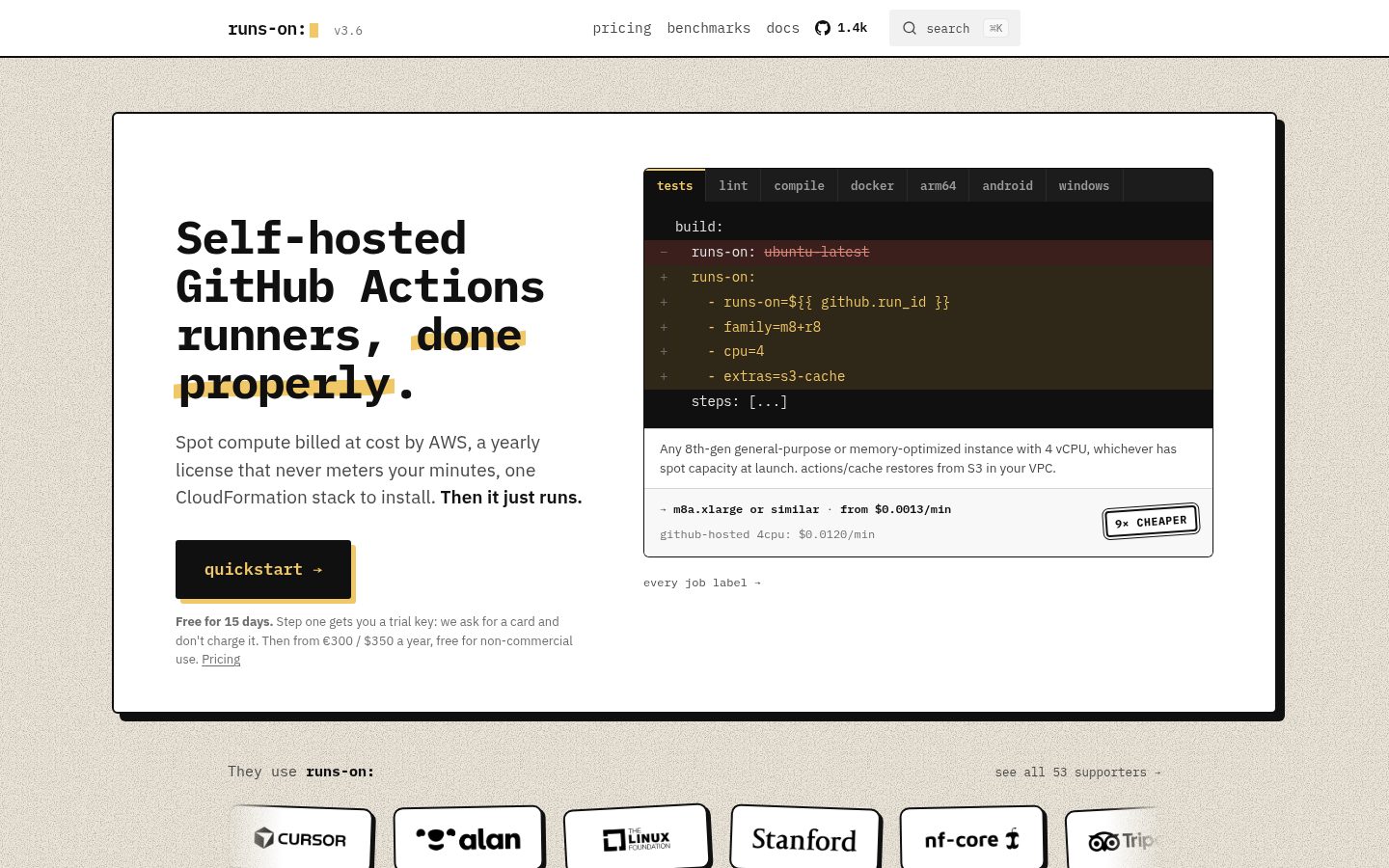
Self-hosted GitHub Actions runners made simple. For AWS. 10x cheaper, up to 2x faster, and unlimited caching. Best alternative to Actions Runner Controller.
Automatically checked · GitHub checked 2026-11-16
Overview
RunsOn
Cut CI spend, speed up builds, and keep your runner infrastructure fully under your control.
RunsOn is the self-hosted GitHub Actions control plane for AWS. It launches an isolated EC2 runner for every job with full GitHub Linux runner-image compatibility.
You keep IAM, networking, images, caches, and the AWS bill under your control. RunsOn handles the runner lifecycle—without an ARC cluster, a homegrown runner platform, or a SaaS execution plane in the job path.
Install RunsOn · See the calculator · Read the docs
Proven at production scale
2.13M jobs in one day
RunsOn customers launched 24.7 fresh runners per second, sustained across the day. Read the scale report.
Published cost and performance comparisons:
- 7× lower 2-vCPU Linux cost: $0.0009/min on c8a.large versus $0.0060/min on GitHub-hosted Linux.1
- Up to 13× lower T4 GPU cost: $0.0041/min on g4dn.xlarge versus $0.0520/min on GitHub-hosted GPU.1
- Up to 89% higher single-thread CPU performance: m8azn runners score 4,299 versus 2,269 for GitHub-hosted Linux.1
Why RunsOn
- ✅ Faster. Choose high-frequency EC2 families instead of accepting the fixed CPUs behind GitHub-hosted runners.
- ✅ Cheaper. Pay spot or on-demand AWS rates with no per-minute markup—often 5–13× less than GitHub-hosted runners.
- ✅ Simpler. Deploy one CloudFormation stack or Terraform module. RunsOn launches a fresh runner for every job and scales back to zero.
- ✅ Compatible. Use Linux AMIs built from GitHub's full runner images, refreshed every 15 days, so existing actions and toolchains keep working. Bring your own AMI when needed.
Why platform teams choose RunsOn
- Keep AWS as the policy boundary. The control plane, runners, cache, and GitHub credentials stay in your account, under your IAM and network controls.
- Standardize without constraining. Publish approved runner shapes for common workloads while preserving access to specialized hardware and images.
- Make CI cost observable. Export telemetry with OpenTelemetry, inspect per-job costs, and enforce AWS budgets.
Choose who owns your runner control plane
RunsOn: own the AWS boundary
Keep the control plane, runners, cache, credentials, and bill in your AWS account. RunsOn handles the runner lifecycle without adding a Kubernetes cluster, controller, autoscaler, or runner-image pipeline.
ARC: own a Kubernetes runner platform
ARC fits Kubernetes-first teams that want runner pods beside other cluster workloads. Your team operates the cluster, controller, autoscaling, and runner images.
Hosted runner SaaS: let the provider own it
A hosted runner service operates the platform for you. In return, you accept its hardware catalog, billing model, and execution trust boundary.
Compare RunsOn and ARC in detail.
Choose who controls runner selection
Use Flex when workflow authors should choose the runner for each job. Use Fleet when the platform team should publish an approved runner catalog.
Flex and Fleet use separate control-plane deployments. They can run in the same AWS account and share one license. Standardize common workloads with Fleet, then use Flex where a job needs something different. Compare Flex and Fleet.
Flex: describe the runner in the workflow
A Flex label can select compute, image, storage, networking, and optional capabilities for one job:
# .github/workflows/ci.yml
jobs:
  build:
    runs-on: runs-on=${{ github.run_id }}/family=c8a+m8a/cpu=4/ram=8+16/image=ubuntu24-full-x64/extras=s3-cache/volume=100gb:gp3
    steps:
      - uses: actions/checkout@v7
      - run: make test
This job requests 4 vCPUs, 8–16 GB of RAM, either the c8a or m8a family, a GitHub-compatible full Ubuntu image, S3 caching, and a 100 GB gp3 volume. Other jobs can request a GPU, ARM64, a custom AMI, a static IP, or private networking in the same way.
Fleet: publish an approved catalog
The platform team defines named runner shapes and capacity limits as Terraform inputs:
# fleet.auto.tfvars
runners = {
  linux-build = {
    cpu    = 4
    ram    = [8, 16]
    family = ["c8a", "m8a"]
    image  = "ubuntu24-full-x64"
    extras = ["s3-cache"]
  }
}

fleets = {
  linux-build = {
    timezone     = "UTC"
    runner       = "linux-build"
    runner_group = "platform"
    max_runners  = 200
  }
}
Workflow authors select the published fleet by name:
# .github/workflows/ci.yml
jobs:
  build:
    runs-on: runs-on/fleet=linux-build/env=production
    steps:
      - uses: actions/checkout@v7
      - run: make test
Only the Terraform catalog can change the fleet's CPU, image, cache, runner group, or capacity. Fleet is in early access; pin an exact Terraform module version before rolling it out broadly.
See the Fleet installation guide.
Get started
Choose who should control runner shapes, then move one workflow:
- Choose the operating model. Use Flex when workflows should choose their own labels, or publish a Fleet catalog for centralized control.
- Deploy into your AWS account. Install Flex with CloudFormation or the Terraform/OpenTofu module, or deploy Fleet through the Fleet installation guide.
- Connect GitHub and move one job. Complete the private GitHub App setup—or the enterprise PAT setup for Fleet—then update the workflow's
runs-onvalue.
Built for real CI
- Match the hardware to the workload. Run Linux, Windows, ARM64, and GPU jobs.
- Cut compute costs without making jobs fragile. Use spot instances with on-demand fallback.
- Skip runner-image maintenance—or keep your own. Use public runner-image AMIs or bring your own AMI.
- Reuse expensive build work. Choose the built-in S3 cache, Docker pull-through cache, EFS, or EBS sticky disks.
- Observe usage and control spend. Export telemetry with OpenTelemetry, use CloudWatch, inspect per-job cost estimates, and enforce AWS budgets.
- Fit your network and access model. Use private networking, multi-AZ deployment, static IPs, and controlled SSH access.
Pricing and licensing
RunsOn offers a 15-day commercial trial, free non-commercial use, and a flat annual license from €300/year. EC2, EBS, and S3 stay on your AWS bill, at cost. Review pricing and licensing.
This public repository contains MIT-licensed CloudFormation assets and supporting files. The RunsOn server and agent are commercially licensed. See SPONSORSHIP.md and current pricing for source-access terms.
Footnotes
-
Prices are US East spot comparisons with a 30 GB gp3 root volume. CPU figures are PassMark single-thread scores. AWS prices change; use the live calculator for your region and workload. ↩ ↩2 ↩3