
Routerly
Self-hosted LLM gateway that routes requests across AI providers (OpenAI, Anthropic, Gemini, Mistral, Ollama) using intelligent multi-policy scoring — including an LLM-native routing policy. Drop-in compatible: just swap the base URL. No database required, built-in cost tracking, budget enforcement and multi-tenant iso
Automatically checked · GitHub checked 2026-11-14
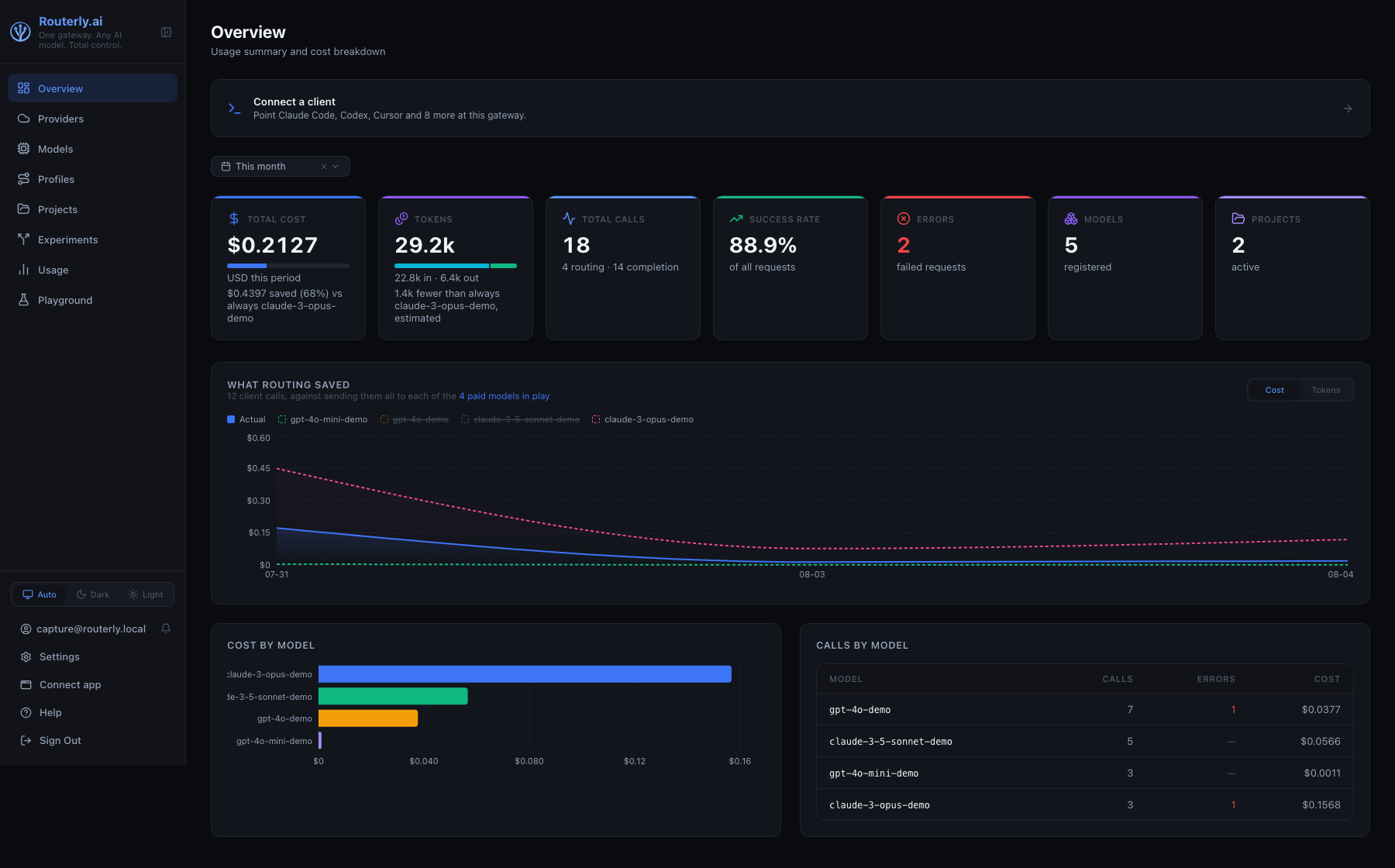
Overview

Routerly
One gateway. Any AI model. Total control.
The self-hosted decision and control layer for your LLM providers: composable routing policies with explainable decisions, governance (roles, budgets, audit), and wire-format transparency.
Compatible with the OpenAI and Anthropic APIs: change the base URL, nothing else.







Quick Start
macOS / Linux:
curl -fsSL https://www.routerly.ai/install.sh | bash -s -- --version v0.5.3
Windows (PowerShell):
powershell -c "& ([scriptblock]::Create((irm https://www.routerly.ai/install.ps1))) -Version v0.5.3"
The commands pin v0.5.3 because the default channel and the Docker latest tag still resolve to an older release. See Installation options.
Docker:
docker run -d \
  --name routerly \
  -p 3000:3000 \
  -v routerly_data:/data \
  -e ROUTERLY_HOME=/data \
  --restart unless-stopped \
  inebrio/routerly:v0.5.3
Then:
- Open
http://localhost:3000/dashboardand create the admin account (first-run Setup screen). - Log in from the CLI, register a model, create a router and attach the model:
routerly auth login --url http://localhost:3000 --email [email protected]
routerly model add --id gpt-5-mini --provider openai --api-key sk-YOUR_KEY
routerly router create --name "My App"        # prints the router token (sk-rt-…), shown once
routerly router model add "My App" gpt-5-mini
- Point your client at
http://localhost:3000/v1(OpenAI format) orhttp://localhost:3000(Anthropic format) and use the router token as the API key.
If the service is not running (for example after a source build), start it with routerly start.
Learn more: Quick Start tutorial — Installation options and update channels — Dashboard guide — CLI reference
What Routerly is
Routerly sits between your applications and your LLM providers. It is the layer that decides where each request goes and controls who may send what, while staying invisible to the client.
- Decide: composable routing policies score every candidate model, and every decision can be explained (routing trace, Playground, per-call usage records). Routing is one function of the layer, not the whole of it.
- Control: roles and permissions, per-router and per-token budgets, guardrails, PII scrubbing, audit log, notifications.
- Stay transparent: clients change only the base URL. Routerly adds no custom headers and no non-standard fields, and returns the provider's response as it received it. The only payload changes are the ones you switch on yourself (PII scrubbing, guardrail steering, token optimizers), each off unless configured.
No database and no Redis: configuration lives in JSON files.
Capabilities
- Routers, orchestrators and passthrough. A router scores models with routing policies. An orchestrator forwards to a priority-ordered list of other routers. A passthrough router forwards a client's own credential straight to OpenAI or Anthropic (optionally alongside real target models).
- 11 routing policies, combined into one ranking (table below), plus routing profiles: reusable presets for routing, optimizers and security. Four built-in routing profiles (
auto,cheap,fast,coding), clonable. - Budgets and cost tracking. Every request is priced per token; hard limits (hourly, daily, weekly, monthly, yearly and rolling windows) at global, router and token level block overspending before the call.
- Guardrails and PII scrubbing. Rule-based and judge-based content guardrails, and PII policies, on requests, responses, or both.
- 8 token optimizers (
session-dedup,ccr,rtk,headroom,json-table,relevance,caveman,llmlingua-2), off by default, enabled per router. - Experiments. A/B test whole routers against each other (model sets, profiles, optimizer pipelines, guardrails) without any client change.
- Resilience. Automatic fallback to the next candidate on provider errors or timeouts.
- Roles and permissions. Custom roles over 26 granular permissions, per-user two-factor authentication, router members.
- Audit log of management actions.
- Notifications to the in-app inbox, email (SMTP, SES, SendGrid, Azure, Google) and webhooks (generic, Slack, Teams, PagerDuty, Discord).
- MCP server. Personal MCP tokens let Claude Code, Cursor, Cline and other MCP clients inspect and adjust Routerly with your own permissions.
- Dashboard, CLI and API. Every function is available in all three; the dashboard also has a Playground with routing trace and cost breakdown.
- Updates. Built-in update check against GitHub Releases; channels
latest,current,next,develop; update withrouterly update runor from the dashboard.
Routing policies
Policies run in order; each filters or scores the candidates, and the highest combined score wins. A failed call falls back to the next candidate.
| Policy | What it does |
|---|---|
llm | Asks a language model to pick the best candidate given the request |
semantic-intent | Classifies the request intent with embeddings and prefers models suited to it |
model-preference | Prefers the model the client named; abstains when the client sends the virtual model routerly/ada |
cheapest | Minimises estimated cost |
health | Deprioritises models with recent errors |
performance | Favours models with lower observed latency |
capability | Matches models to task requirements (vision, tools, JSON mode, thinking) |
context | Filters models by context window versus prompt size |
budget-remaining | Excludes models that would push a router over its budget |
rate-limit | Steers traffic away from rate-limited providers |
fairness | Balances load across candidates |
How Routerly compares
Last verified: 2026-10-21, against each project's public README and documentation at that date. "n/v" means not verifiable from public documentation.
| Routerly (0.5.x) | LiteLLM proxy | Bifrost | Portkey OSS gateway | OpenRouter | |
|---|---|---|---|---|---|
| Self-hosted | ✅ | ✅ | ✅ | ✅ | ❌ hosted service |
| Open source | AGPL-3.0 | open core, enterprise features under a commercial license | Apache-2.0 (enterprise tier exists) | MIT (hosted/enterprise tier exists) | n/a |
| OpenAI-compatible API | ✅ | ✅ | ✅ | ✅ | ✅ |
Anthropic Messages API (/v1/messages) | ✅ | ✅ | ✅ (/anthropic) | n/v | n/v |
| Database for core use | none (JSON files) | PostgreSQL recommended for production; virtual keys and spend tracking use it | n/v | n/v | n/a |
| Routing | 11 composable policies, profiles, orchestrators | fallback, weighted, latency, cost, usage, least-busy strategies | routing rules, key/provider load balancing, fallbacks | fallbacks, retries, weighted load balancing | n/v |
| LLM- or intent-based routing | ✅ (llm, semantic-intent) | n/v | n/v | n/v | n/v |
| Budgets / spend control | ✅ global, router, token | ✅ spend tracking and limits per key/team/user | ✅ virtual keys, teams, customers | n/v | n/v |
| Guardrails | ✅ built in (rules, judge, PII) | ✅ | enterprise tier | ✅ input/output checks (PII redaction listed as enterprise) | n/v |
| Token optimizers | ✅ 8, opt-in | n/v | n/v | n/v | n/v |
| MCP | management MCP server (not a tool gateway) | MCP gateway | MCP client and server | MCP gateway (separate product) | n/v |
| Roles and permissions | ✅ custom roles, 26 permissions | n/v (SSO listed as enterprise) | enterprise tier | n/v | n/v |
| SSO (OIDC/LDAP) | not yet | enterprise | enterprise | n/v | n/v |
| Web UI | ✅ dashboard | ✅ admin UI | ✅ built-in | local log console | hosted dashboard |
These gateways overlap with Routerly and are not mutually exclusive: several can sit behind Routerly as an upstream (anything that speaks the OpenAI or Anthropic API can be registered as a custom provider), and Routerly can sit in front of them.
Use Cases
SaaS with multiple tenants
Create one router per tenant, give each its own token and monthly spend cap. A tenant cannot exceed its budget or see another's traffic, and your app code does not change.
Local-first development
Develop against Ollama locally and promote to a hosted model in production. Same API surface in every environment; only the router token changes.
Cost optimisation without quality loss
Combine cheapest, capability and context (or the built-in cheap profile) to send simple requests to cheap models and fall back to a stronger model only when the task needs it. Token optimizers reduce the prompt on top.
Resilience and failover
Register equivalent models across several providers and enable health. Routerly routes around failing endpoints and tries the next candidate on error.
Governance for teams
Roles and permissions decide who can change what, the audit log records changes, guardrails and PII policies apply to every request, and notifications report budget and provider events.
Comparing setups safely
Run an experiment between two routers (for example a cheaper model set against the current one) and compare cost, latency and error rate in the dashboard.
Dashboard
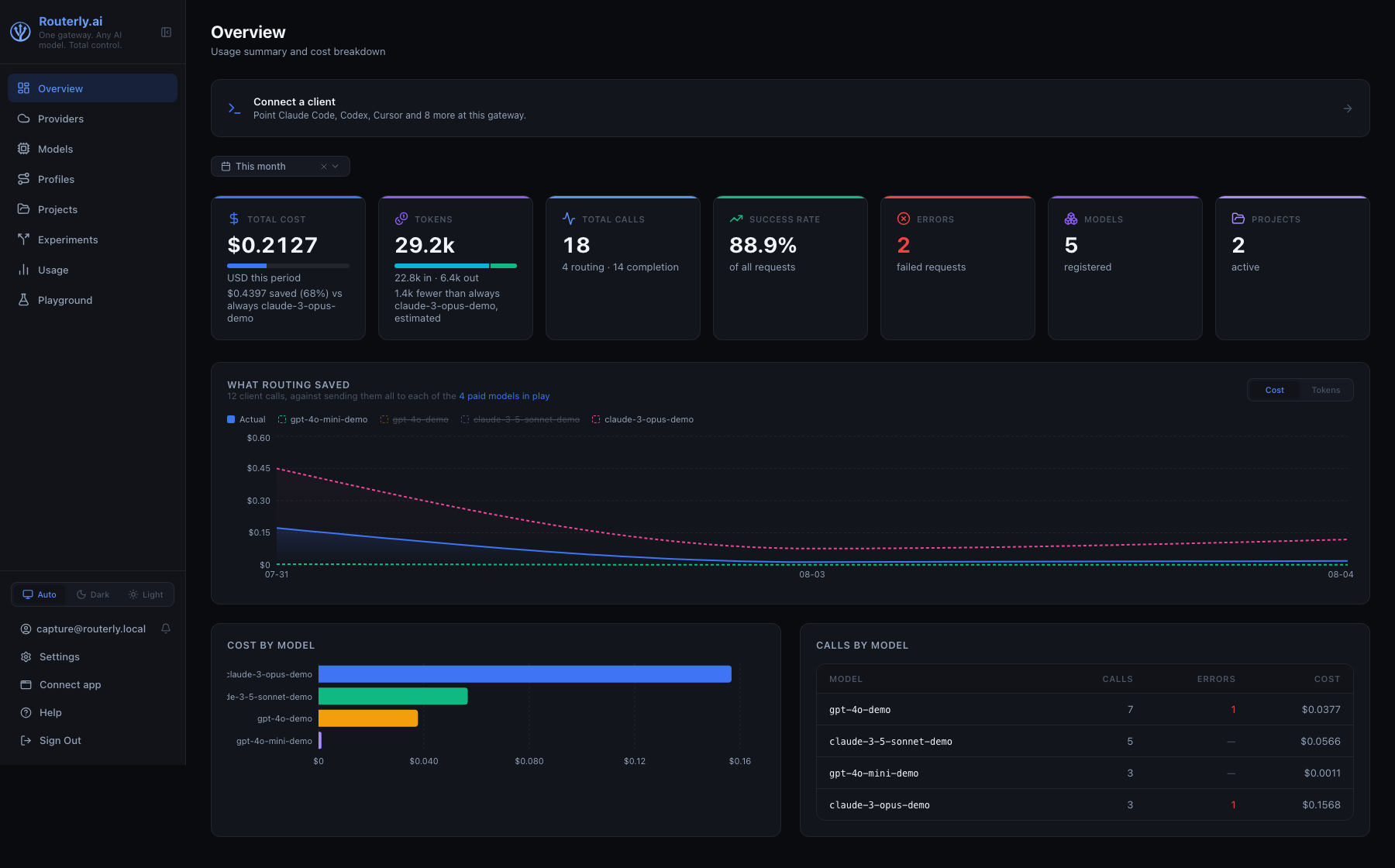
Overview: cost, calls and what routing saved
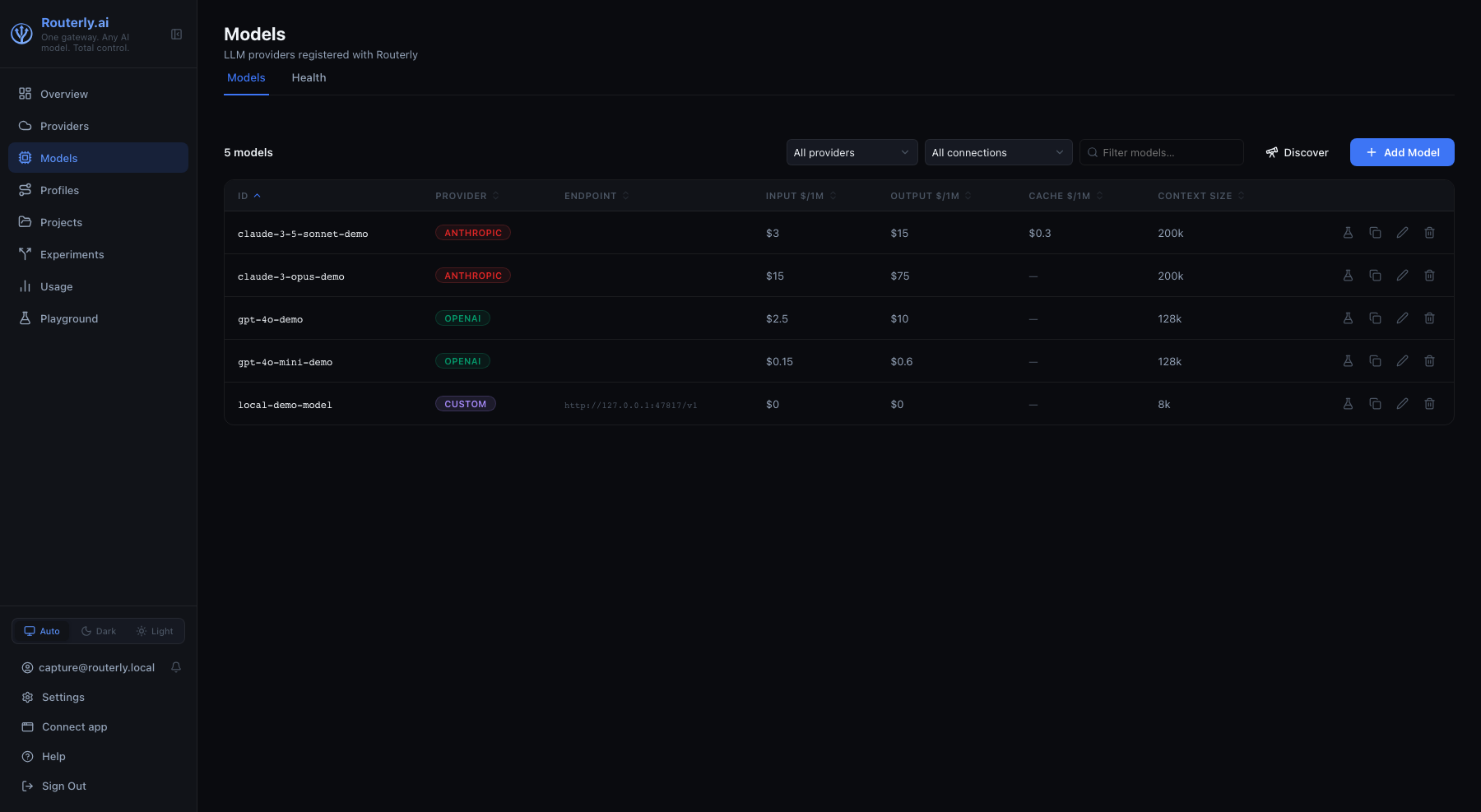
Models: providers, endpoints and pricing
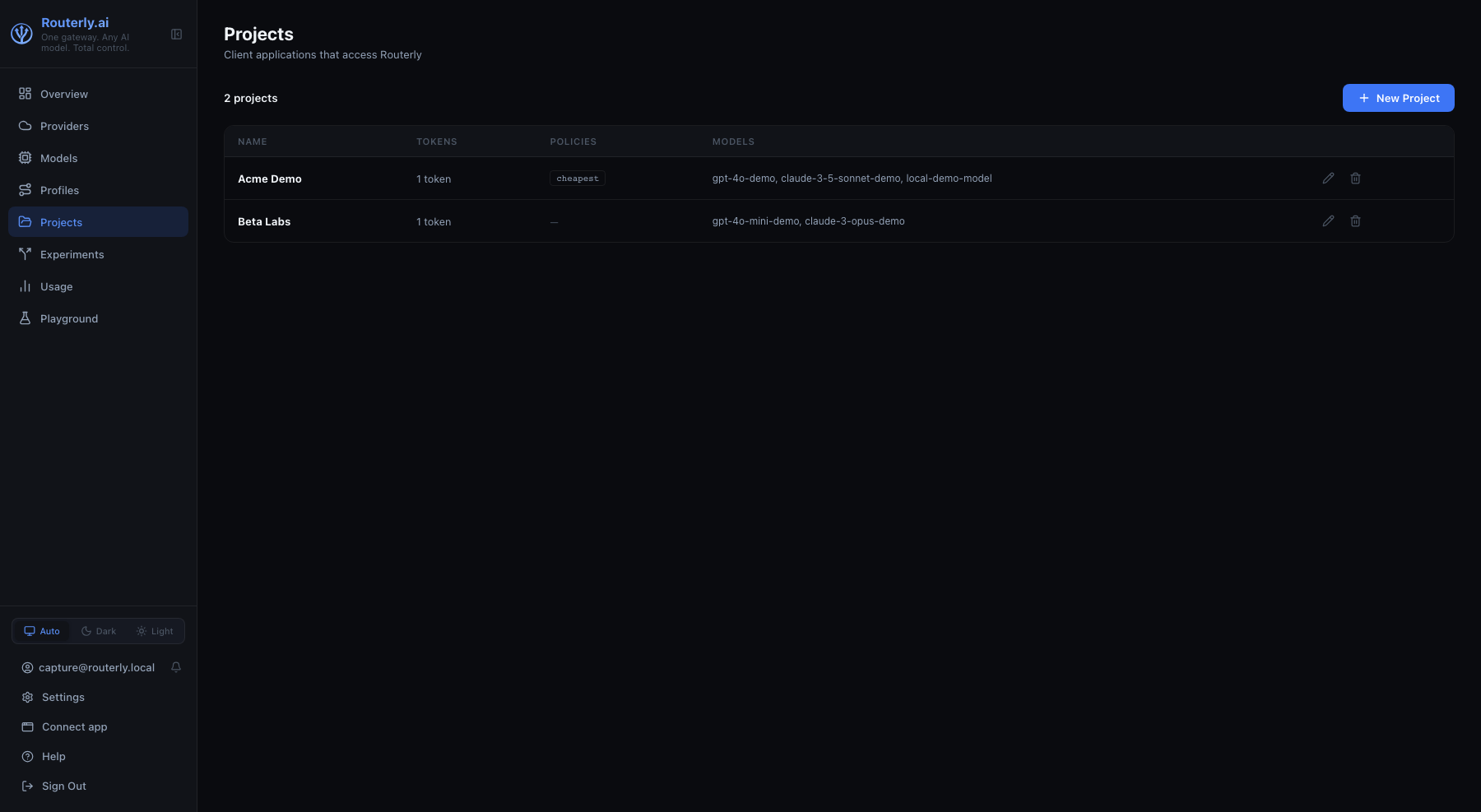
Routers: tokens, budgets and routing per tenant
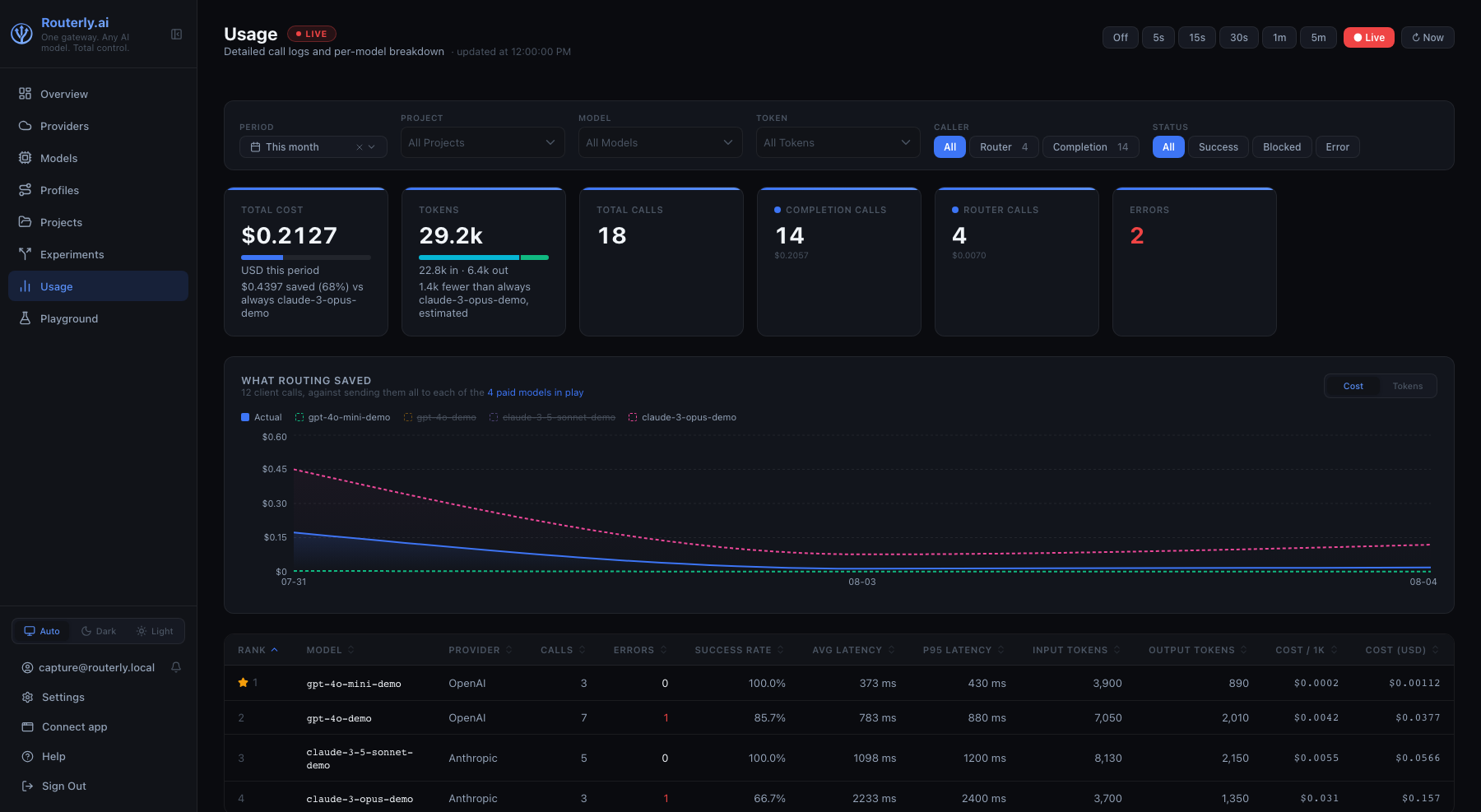
Usage: filter by time range, model and router
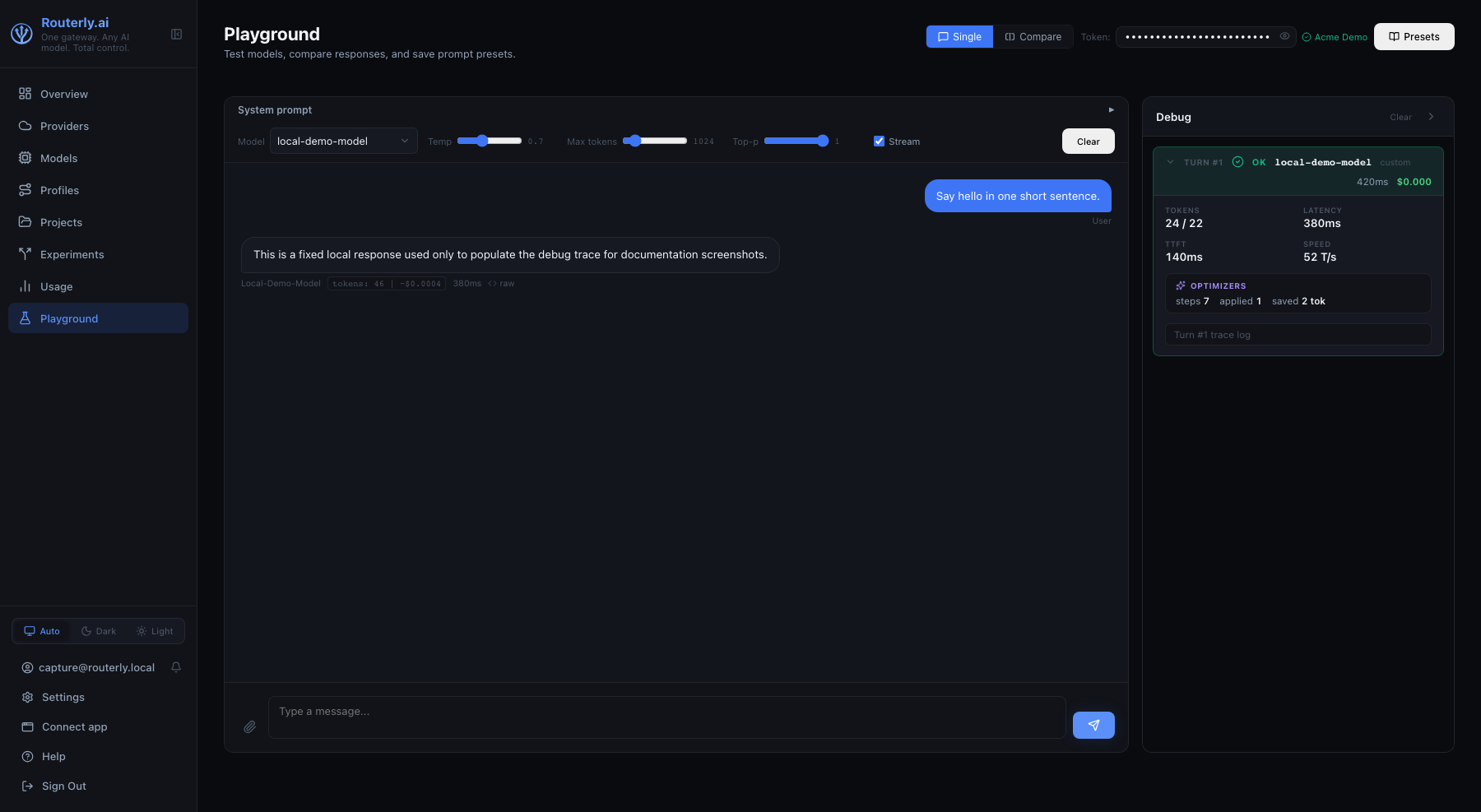
Playground: test in the browser, with routing trace and cost breakdown
Works with any OpenAI or Anthropic client
Routerly serves the OpenAI (/v1/chat/completions, /v1/responses) and Anthropic (/v1/messages) formats, so tools that speak either protocol work by changing the base URL.
| Tool | Protocol | Notes |
|---|---|---|
 | OpenAI | Python, Node.js, .NET, Java, Go |
 | Anthropic | Python and Node.js SDKs, including streaming |
 | OpenAI | Set the API base URL in Settings → Connections |
 | Anthropic / OpenAI | Custom endpoint pointing to Routerly |
 | OpenAI | Use ChatOpenAI with base_url override |
 | OpenAI | OpenAI(api_base=...) constructor |
 | OpenAI | Add a custom model via Settings → Models |
 | OpenAI | config.json, set apiBase to the Routerly URL |
 | OpenAI | Configure as a custom OpenAI endpoint |
Any fetch/curl | OpenAI / Anthropic | Standard HTTP, no SDK needed |
Python (OpenAI SDK):
from openai import OpenAI

client = OpenAI(
    base_url="http://localhost:3000/v1",
    api_key="sk-rt-YOUR_ROUTER_TOKEN"   # printed by `routerly router create`
)
response = client.chat.completions.create(
    model="gpt-5-mini",
    messages=[{"role": "user", "content": "Hello!"}]
)
Python (Anthropic SDK):
import anthropic

client = anthropic.Anthropic(
    base_url="http://localhost:3000",
    api_key="sk-rt-YOUR_ROUTER_TOKEN"
)
message = client.messages.create(
    model="claude-haiku-4-5",
    max_tokens=1024,
    messages=[{"role": "user", "content": "Hello!"}]
)
Supported Providers
OpenAI, Anthropic, Google Gemini, Mistral, Cohere, xAI (Grok), DeepSeek, Groq, Together, Perplexity, Fireworks, Cerebras, Azure OpenAI, Amazon Bedrock, Google Vertex AI, Ollama (local), and any OpenAI-compatible endpoint as a custom provider. Subscription logins are available for OpenAI and Anthropic (openai-oauth, anthropic-oauth; see the guides); the unofficial session-cookie adapters (openai-web, anthropic-web) are configured as connections, see ChatGPT web and Claude web. The model catalog is fetched at runtime, so models and prices update without a new release.
A single router can span cloud and local models. Details: Providers.
Benchmarks
Independent benchmarks are published in the routerly-benchmark repository.
Documentation
Full documentation is available at https://doc.routerly.ai.
| Installation | One-line install, update channels, Docker, build from source |
| Quick Start | First model, router and API call in 5 minutes |
| Configuration | Settings file, environment variables |
| Architecture | Routers, orchestrators, passthrough, request lifecycle, tracing |
| Routers | Router configuration, tokens, members |
| Routing | All 11 routing policies, profiles, selectors |
| Budgets & Limits | Cost caps and enforcement |
| Security policies | Guardrails and PII scrubbing |
| Optimizers | Token optimizers |
| Experiments | A/B tests between routers |
| MCP | MCP server and tokens |
| Notifications | Channels and events |
| Dashboard | Web UI walkthrough |
| CLI Reference | Every command with examples |
| API Reference | LLM proxy and management API |
| Self-Hosting Guide | Docker, systemd, nginx, production checklist |
| Integrations | Cursor, Open WebUI, LangChain, LibreChat, and more |
Configuration
All configuration lives in ~/.routerly/ (plain JSON files, no database). See Config files for the exact layout and Environment variables for overrides.
Override the base path with ROUTERLY_HOME=/custom/path. When running via Docker, configuration and data live in the routerly_data volume mounted at /data.
Security
Routerly is a TypeScript / Node.js project with no Python dependency. API keys are stored encrypted, router and MCP tokens only as SHA-256 hashes, passwords with bcrypt. See SECURITY.md for vulnerability reporting and supply chain notes.
Contributing
Contributions are welcome. See Releasing for version bumps and the maintainer release procedure.
Roadmap
Enterprise SSO
Log in to the dashboard with an existing identity provider (OAuth 2.0 / OIDC, LDAP). Not available yet: dashboard users are local accounts today.
License
Routerly is licensed under AGPL-3.0. For commercial licensing inquiries: [email protected]