
mira
Self-hosted AI code reviewer with indexed PR reviews, walkthroughs, vulnerability scanning, dependency graphs, custom rules, and a learning loop.
Automatically checked · GitHub checked 2026-11-17
Overview

Mira
Self-hosted AI code review. Your code, your dashboard, your LLM key.


Docs · Community · Self-Host Guide » · Benchmark
Self-host every feature: full review engine, codebase indexing, vulnerability scanning, custom rules, org-wide package search, dashboard, learning loop. No paid tier, no license key, no SaaS upsell.
Mira reviews your pull requests using your choice of LLM (via OpenRouter, which fronts Anthropic, OpenAI, Google, DeepSeek, and more) and posts concise, actionable feedback. The noise filter, confidence clamping, and learning loop ensure you only see comments that matter. See FEATURES.md for the full surface.
Why Teams Choose Mira
- Model agnostic — Run Claude, GPT, Gemini, DeepSeek, Llama, or any OpenAI-compatible endpoint: OpenRouter, vLLM, Ollama, Together, Groq, Fireworks, or AWS Bedrock direct. Per-provider quirks are config, not code, so adding a provider is a one-line entry.
- Zero markup on LLM costs — Bring your own key. You pay the model provider directly; Mira never proxies your spend or adds a multiplier. The dashboard shows real per-repo, per-model cost — not estimates.
- Learns from your context — Mira synthesizes rules from your merged PRs: rejected comments and human review patterns become team rules that shape future reviews.
- You set the rules — Define custom and org-wide review rules in plain language, per-repo via
.mira.yamlor from the dashboard. - Privacy first — Self-hosted by default. Diffs, indexes, review history, and CVE data live in your SQLite or Postgres, on infra you own. No phone-home, no required telemetry, no "is this used for training?"
- Low-noise reviews — Confidence thresholds, dedup, a self-critique pass, and per-PR caps mean every comment is one worth reading — Mira has the best precision of any top-tier tool on the public Code Review Bench, on a model that costs cents per review.
- Catches PRs stepping on each other — While reviewing, Mira checks the repo's other open PRs and flags merge-conflict risk and duplicate effort right in the walkthrough.
- Indexed, cross-file context — A full-repo code index gives the model real project context, not just the diff — plus org-wide package search and hourly OSV.dev CVE scanning across every repo.
- GitHub, GitLab, Forgejo, and Bitbucket Cloud — Auto-reviews every PR and merge request and answers
@miracodeaiquestions inline across GitHub, GitLab, Forgejo (incl. Codeberg), and Bitbucket Cloud. The engine, indexer, and dashboard are provider-agnostic, so a new host is a data entry plus one provider class. - Self-host on day one — Docker image with Railway / Fly.io / Render configs, SQLite or Postgres. Every feature included.
Dashboard

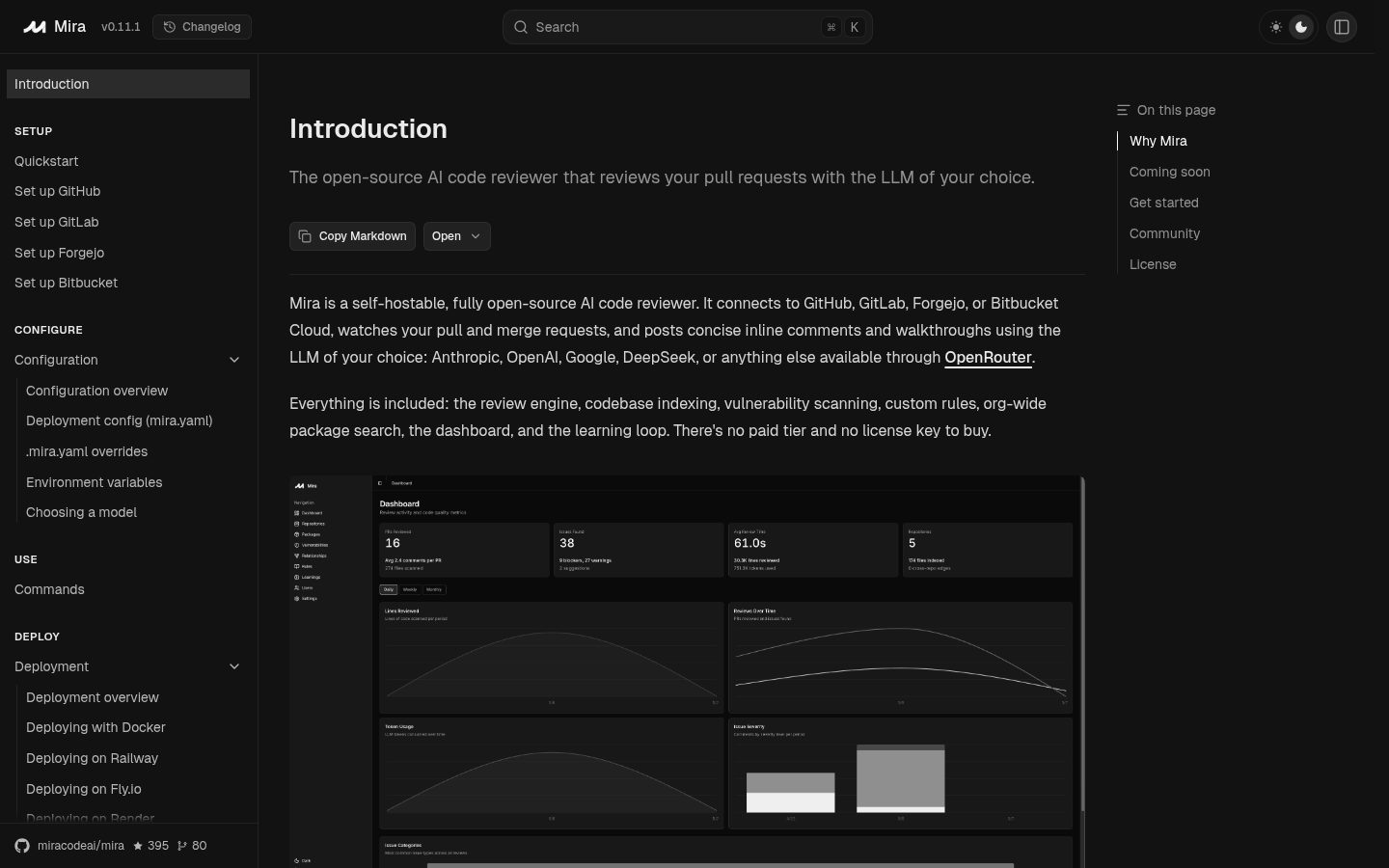
Your data, your dashboard
Most AI reviewers are SaaS: your diffs (and often the full surrounding code) leave for a third-party server, and the only "view" you get is the comments that come back on a PR. Mira flips both halves of that:
- Your code never leaves your infra. Diffs, embeddings, indexes, review history, vulnerability data, all stored in your SQLite or Postgres, on infrastructure you own. No phone-home, no required telemetry, no "is this used for training?" question.
- The dashboard you see above is yours. It's not a marketing screenshot of someone else's view of your code. CodeRabbit, Greptile, and similar SaaS reviewers don't expose anything like it. Mira's dashboard surfaces signals you don't get anywhere else:
- Org-wide package inventory: answer "which repos use
[email protected]?" in one query. Stack it next to your CVE feed for instant blast-radius checks. - CVE alerts on every dependency: hourly OSV.dev poll, severity + advisory link + fix version surfaced inline next to the package.
- Dependency + blast-radius graphs: see exactly which files and repos depend on a symbol before you change it.
- Per-repo review event stream: every webhook, every chunk, every cost figure, in one place for live troubleshooting.
- Cost & token telemetry: actual spend per repo and per model, not estimates, because you control the LLM key.
- Review-health page: stale/waiting PRs, a reviewer-responsiveness leaderboard, throughput trends, and rubber-stamp detection (approvals with no substantive review) — plus per-contributor analytics with a year-long heatmap and Mira's review-quality signal.
- Coming soon, change-frequency heatmaps: surface the files that bug fixes keep landing on so you can target review attention.
- Org-wide package inventory: answer "which repos use
If your engineering team needs answers like "which of our repos are exposed to this CVE?" or "what's the blast radius of changing this function?", those questions stop being multi-day investigations and start being one-click dashboard pages.
Benchmark
On the full 50-PR offline set of the public Martian Code Review Bench, Mira running an inexpensive model (DeepSeek v4.1 flash) ranks first on F1 of 23 published reviewers and posts the fewest unmatched comments of any tool above 50% recall. Run on 6 November 2026.

| Reviewer | Precision | Recall | F1 | TP / FP / FN |
|---|---|---|---|---|
| Mira · DeepSeek v4.1 flash | 75.0% | 55.1% | 63.5 | 87 / 29 / 71 |
| Cubic v2 | 56.5% | 60.8% | 58.5 | 96 / 74 / 62 |
| Qodo Extended v2 | 56.2% | 57.0% | 56.6 | 90 / 70 / 68 |
| Augment | 52.4% | 61.4% | 56.6 | 97 / 88 / 61 |
| Devin | 67.3% | 41.8% | 51.6 | 66 / 32 / 92 |
| Qodo v2 | 47.1% | 56.3% | 51.3 | 89 / 100 / 69 |
| Cursor Bugbot | 54.3% | 44.3% | 48.8 | 70 / 59 / 88 |
| GitLab Duo | 47.5% | 48.1% | 47.8 | 76 / 84 / 82 |
| Greptile v4.1 | 46.9% | 48.1% | 47.5 | 76 / 86 / 82 |
| GitHub Copilot v2 | 34.3% | 62.0% | 44.1 | 98 / 188 / 60 |
| CodeRabbit | 33.8% | 58.2% | 42.8 | 92 / 180 / 66 |
| Claude Code | 36.5% | 41.1% | 38.7 | 65 / 113 / 93 |
The full ranking of all 23 reviewers, per-PR results, head commits and settings are in benchmark-results.json.

Mira sits furthest up on the precision axis at a recall most tools don't reach: the tools that find a few more bugs (Cubic, Augment, Copilot, CodeRabbit) post two to six times as many comments that match nothing in the reference set.
Median review time was 106 seconds per PR; all 50 reviews completed.
Methodology: all 50 PRs of the Martian Code Review Bench offline dataset, reviewed once each with Mira's default settings (reasoning effort
medium, 16k-token output budget) and scored with the benchmark's own matching prompts and Claude Sonnet 4.5 as the judge; competitor rows are the benchmark's published results on the same PRs. Settings, per-PR results and commit pins are inbenchmark-results.json.
Quick Start
Run Mira self-hosted to auto-review every PR and merge request and answer @miracodeai questions inline. GitHub (as a GitHub App), GitLab (via a group/project access token), Forgejo/Codeberg (via an access token), and Bitbucket Cloud (via an access or API token) are all supported.
1. Deploy — one-click on Railway, or with Docker:

# mira.yaml — deployment-wide defaults. Every key is optional.
llm:
  model: "anthropic/claude-sonnet-4-6"
  indexing_model: "anthropic/claude-haiku-4-5"
# .env — secrets only.
MIRA_GITHUB_APP_ID=123456
MIRA_GITHUB_PRIVATE_KEY="$(cat private-key.pem)"
MIRA_WEBHOOK_SECRET=your-secret
OPENROUTER_API_KEY=sk-or-...
docker run -p 8000:8000 --env-file .env \
  -v "$(pwd)/mira.yaml:/app/mira.yaml" \
  ghcr.io/miracodeai/mira:latest --config /app/mira.yaml
2. Install the app on your repos — every PR gets reviewed.
Bitbucket Cloud — instead of the GitHub App creds, set:
# A workspace/project/repository access token (Bearer), or an API token as email:token.
# Scopes: repository read, pull requests read+write, webhooks read+write.
MIRA_BITBUCKET_TOKEN=ATCTT3x...
MIRA_BITBUCKET_WEBHOOK_SECRET=your-secret
MIRA_BITBUCKET_WORKSPACE=your-workspace   # optional: dashboard repo discovery scope
MIRA_BITBUCKET_BOT_USER=mira              # optional: bot nickname if the token can't read /user
Then add a workspace (or repository) webhook pointing at https://<mira-host>/bitbucket/webhook with the same secret and the triggers Repository: Push, Pull request: Created, Updated, Merged, Comment created. Bitbucket PRs have no labels, so @mira pause state is kept in Mira's database. Comment commands check repository permission through the workspace permissions API, which needs admin rights; otherwise list reviewers' account ids in commands.allowed_users. Bitbucket nicknames are not unique, so authorization and the allowlist match the commenter's account id, never the nickname.
→ Full walkthrough: creating the GitHub App & quickstart · GitLab setup · deploy options · choosing models, custom endpoints & AWS Bedrock
Review a local branch
From a Git checkout, compare committed HEAD with its merge base against a local ref:
mira review --base main
Mira pins the diff, supporting source reads, and convention documents such as
AGENTS.md to the committed branch. Staged, unstaged, and untracked source edits
are excluded. The command uses CLI configuration without dashboard overrides
or a Git hosting token. Use --output json for machine-readable findings.
Codex CLI
If you already use OpenAI Codex locally, Mira can run reviews through the
Codex CLI instead of an HTTP API key. Authentication stays inside Codex via
CODEX_HOME/auth.json, created by codex login:
# mira.yaml
llm:
  provider: "codex-cli"
  model: "codex-default"      # use the Codex CLI default model
  codex_home: "/run/codex"    # optional; defaults to CODEX_HOME
  codex_sandbox: "read-only"  # the only accepted sandbox policy
  codex_timeout_seconds: 900  # optional
The official Mira image includes a pinned Codex CLI. Mount a Codex login read-only:
docker run -p 8000:8000 --env-file .env \
  -e CODEX_HOME=/run/codex \
  -v "$HOME/.codex:/run/codex:ro" \
  -v "$(pwd)/mira.yaml:/app/mira.yaml:ro" \
  ghcr.io/miracodeai/mira:latest --config /app/mira.yaml
This provider does not require OPENROUTER_API_KEY. Mira copies only auth.json
from the read-only mount into a private, writable temporary Codex home for each
invocation. It launches Codex in an empty temporary workspace with a minimal
environment, disables inherited shell environment variables and user/project
rules, and enforces the read-only sandbox.
Provider choice, executable/auth paths, sandbox policy, and timeout are
deployment-only settings; repository .mira.yaml files cannot override them.
For one-shot mira review runs, --config is treated as untrusted by default.
An operator-owned config may opt in with --trust-execution-settings; never use
that flag with a repository-controlled file.
Codex CLI does not expose Mira's temperature or hard output-token controls, so Mira disables ensemble sampling for this provider. The mounted OAuth session is still a sensitive deployment credential: use a dedicated Codex account/session and isolate the Mira container from unrelated host files and services.
Configuration
mira.yaml (loaded via --config) holds deployment-wide defaults. Drop a .mira.yaml in any repo — or use the dashboard — to override per-repo; both deep-merge over mira.yaml for that repo only:
# .mira.yaml — optional per-repo override
filter:
  confidence_threshold: 0.5  # noisier repo → lower bar
  max_comments: 10
→ Full schema and every key: Configuration docs.
For code-index summaries over an OpenAI-compatible Chat or Responses endpoint,
llm.indexing_temperature defaults to 0.0. Set it to omit to leave the
temperature field out of requests, or to a finite nonnegative number supported
by your endpoint. The dashboard's Indexing Temperature setting overrides
config; Inherit deployment config clears that override. This does not change
reviewer temperature defaults or reasoning effort. Existing reasoning policy may
still omit a numeric temperature. Bedrock uses 0.0 for index summaries.
Codex CLI manages sampling itself.
llm:
  indexing_temperature: omit
Development
git clone https://github.com/miracodeai/mira.git
cd mira
pip install -e ".[dev,serve]"

# Run tests
pytest tests/ -v

# Run the regression suite (hits real GitHub + LLM, ~$1, ~3 min).
# Pinned PRs whose findings have flickered across iterations. Run before
# merging changes that touch prompts, the noise filter, or the engine.
OPENROUTER_API_KEY=... GITHUB_TOKEN=... pytest -m eval -v

# Lint
ruff check src/ tests/

# Type check
mypy src/mira/ --ignore-missing-imports
License
Apache 2.0. See LICENSE.