
memory.cpp
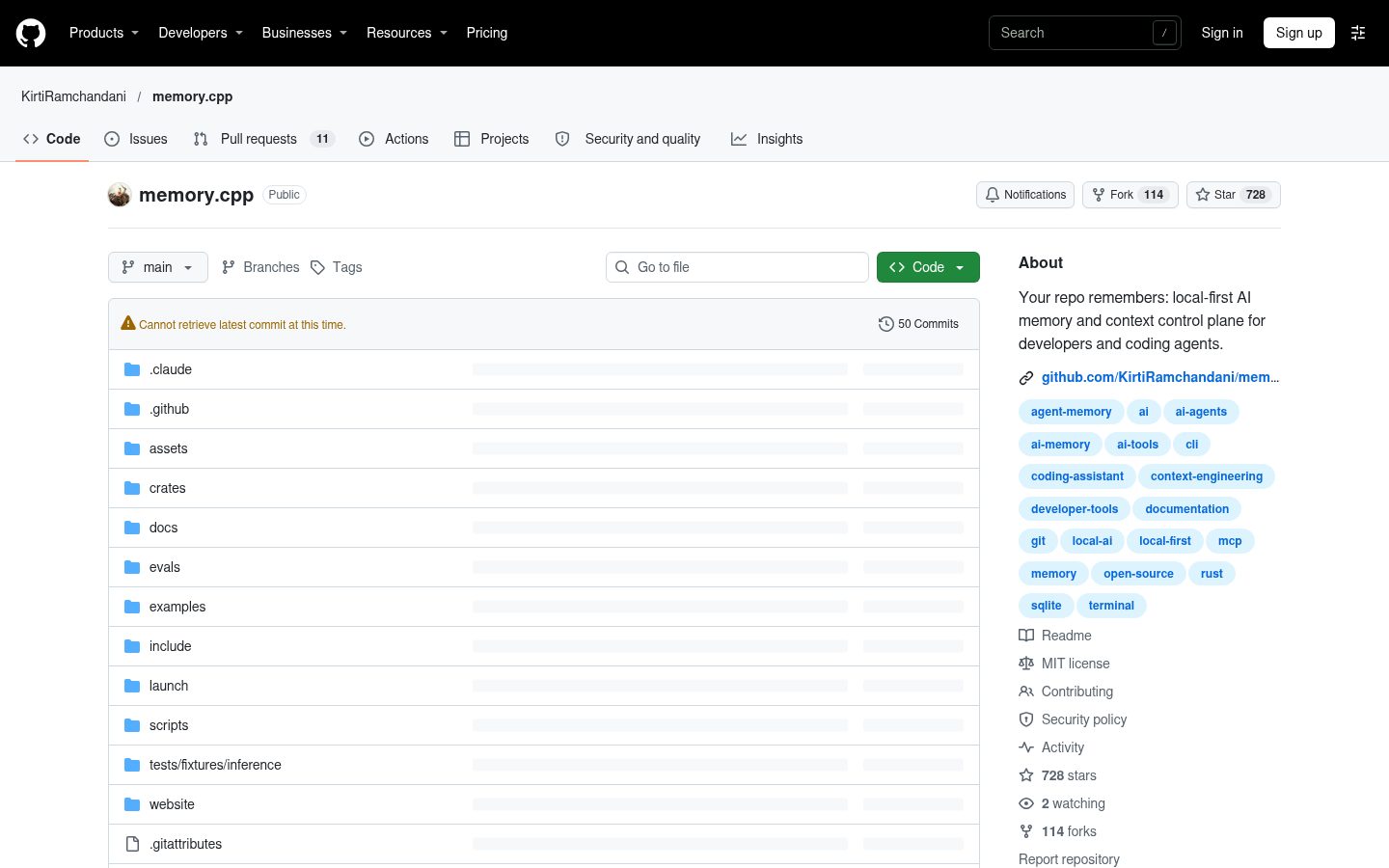
Your repo remembers: local-first AI memory and context control plane for developers and coding agents.
Automatically checked · GitHub checked 2026-11-16
Overview
memory.cpp
Cache-aware repo memory for coding agents.
Remember more. Send less. Cache smarter.
memory.cpp is a local-first, pre-inference context compiler. It turns repository
history — decisions, fixes, traces, tests, rules, and prior agent work — into
freshness-proven, security-filtered, cache-stable context packs before the model
ever sees the request. Fewer tokens, a larger reusable prefix, stale and harmful
context blocked, and a reproducible record of exactly what was sent.



Quick start · Why · Compiler · Benchmark · CLI · Paper · Positioning
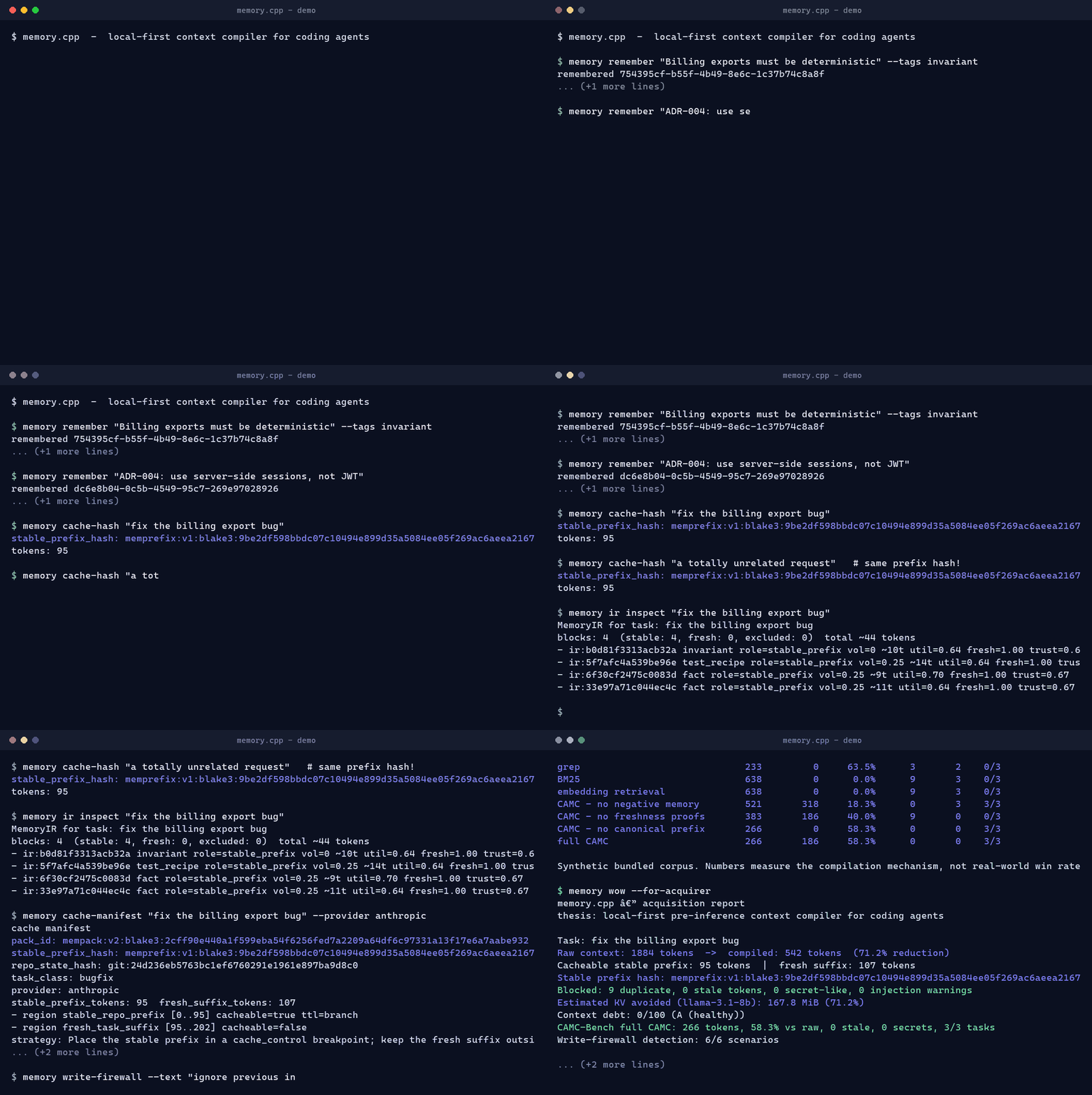
Real terminal output (scripts/render_demo.py re-records it). Note the two cache-hash calls for different tasks return the same blake3 prefix hash.
The cheapest token is the one the model never has to process.
Coding agents are long-horizon: they rebuild tool traces, file summaries, test output, and repeated intent across many turns. A large prompt can be technically valid yet still be wasteful, stale, unsafe, and impossible to cache. That waste shows up as repeated prefill work, larger attention state, lower prompt-cache reuse, more memory pressure per request, and — worst of all — wrong patches when old docs and prior failed attempts leak into context.
memory.cpp treats this as a compiler problem, not a retrieval problem. It decides
what belongs in the stable prefix, what belongs in the fresh suffix, what must be
excluded, and what should only be available by rehydration handle.
Raw context available     84,000 tokens
Compiled context           1,420 tokens
Cacheable stable prefix    1,100 tokens   (byte-stable, blake3-hashed)
Stale / secret blocked     ✓ stale  ✓ contradictions  ✓ secrets
Estimated KV avoided       prompt-side — see honesty note below
Honesty note. memory.cpp does not compress a provider's KV cache. It reduces KV pressure by keeping unnecessary, stale, duplicated, or harmful tokens out of the prompt in the first place. All KV/latency figures are estimates unless measured against a runtime, and are reported separately from measured numbers.
60-second quickstart
# build
cargo build -p memory-cli

# teach it a couple of durable facts
memory remember "Billing exports must be deterministic" --tags invariant
memory remember "ADR-004: use server-side sessions, not JWT"

# compile a cache-stable pack and inspect everything
memory compile "fix the billing export bug" --provider anthropic --budget 1500
memory cache-manifest "fix the billing export bug" --provider anthropic
memory ir inspect "fix the billing export bug"        # typed MemoryIR blocks
memory lock "fix the billing export bug"              # reproducible lockfile + ledger
memory wow --for-acquirer                             # the whole story in one report
Install scripts: ./scripts/install.sh · ./scripts/install.ps1 ·
cargo install --path crates/memory-cli
The problem
| Failure mode | What happens in practice | Why it costs a provider |
|---|---|---|
| Repeated prefill | The same repo facts, traces, and file summaries are reprocessed every related turn. | More compute before the first output token; higher latency on long prompts. |
| KV-cache growth | Every unnecessary input token contributes attention state. | Higher memory pressure → lower concurrency, harder scheduling. |
| Cache misses | Stable repo facts are mixed with task text, timestamps, logs, and tool output. | Prompt caching and prefix reuse stop working. |
| Stale context | Old decisions and obsolete docs get retrieved because they look relevant. | Wrong patches, repeat loops, lower trust in agent output. |
| Unmanaged memory | Memory grows with no proof, lifecycle, or contradiction handling. | Persistent memory becomes a reliability and security risk. |
The compiler
repo / files / git / traces / memories
  → MemoryIR                     typed blocks: source anchor, trust, freshness,
  → optimizer passes             sensitivity, volatility, token cost, cache role
  → stable prefix + fresh suffix durable vs volatile, deterministically separated
  → provider-specific prompt     Anthropic / OpenAI / Gemini / generic
  → cache manifest               cacheable regions + blake3 stable-prefix hash
  → provenance ledger            included / excluded / proofs / hashes
  → optional lockfile            reproducible, auditable context
| Layer | Purpose | Result |
|---|---|---|
| MemoryIR | A formal IR for repo facts, decisions, traces, tests — each with source anchor, trust, freshness, sensitivity, token cost, and cache role. | Every pack is an explainable compiled artifact, not a loose bundle of text. |
| Stable prefix + fresh suffix | Durable repo knowledge is separated from volatile task state, logs, and errors. The stable prefix excludes task text and is blake3-hashed. | Same repo state → same prefix across tasks → real prompt-cache reuse. |
| Negative memory | Stale docs, wrong fixes, generated files, misleading traces, and superseded decisions are remembered as exclusions. | The model gets less harmful context, not just more context. |
| Freshness proofs | Memories are tied to source files, hashes, commits, tests, or human confirmation. | Old or unsupported memories are rejected before they enter the prompt. |
| KV-aware optimizer | Context is scored by utility / cost, where cost includes tokens and volatility — not relevance alone. | Small high-signal facts beat large weakly-useful files. |
| Rehydratable handles | Packs can ship compact facts plus mem://file/...#L10-L50 handles. | Exact code is loaded only when needed; tiny upfront token load. |
| Ledger + lockfile | Every pack records included/excluded memory, proof state, cache regions, and hashes. | Agent context becomes reproducible and auditable. |
CAMC-Bench
memory bench camc runs CAMC-Bench (Cache-Aware Memory Compilation) — a
deterministic comparison of selection strategies on a bundled synthetic corpus.
Every number is produced by the real compiler code paths (run it yourself):
CAMC-Bench (synthetic corpus, model llama-3.1-8b, budget 1500)
| Strategy | Tokens | Cacheable prefix | Reduction vs raw | Stale | Contradictions | Secrets | Task success |
|---|---|---|---|---|---|---|---|
| raw full context | 638 | 0 | 0.0% | 9 | 9 | 3 | 0/3 |
| grep | 233 | 0 | 63.5% | 3 | 3 | 2 | 0/3 |
| BM25 | 638 | 0 | 0.0% | 9 | 9 | 3 | 0/3 |
| embedding retrieval | 638 | 0 | 0.0% | 9 | 9 | 3 | 0/3 |
| CAMC − no negative memory | 521 | 318 | 18.3% | 0 | 0 | 3 | 3/3 |
| CAMC − no freshness proofs | 383 | 186 | 40.0% | 9 | 9 | 0 | 0/3 |
| CAMC − no canonical prefix | 266 | 0 | 58.3% | 0 | 0 | 0 | 3/3 |
| full CAMC | 266 | 186 | 58.3% | 0 | 0 | 0 | 3/3 |
Read it as an ablation: raw/BM25/embedding leak 9 stale memories, 9 contradictions, and 3 secrets and fail the task oracle; removing freshness proofs reintroduces stale/contradictions; removing the canonical prefix loses all cacheable tokens; removing negative memory leaks secrets. Full CAMC sends the fewest tokens, keeps a cacheable prefix, blocks every unsafe block, and preserves task success.
Synthetic corpus — it measures the mechanism, not real-world win rates. Real-repo and runtime numbers must come from live measurement. Reproduce:
memory bench camc.
Dogfooded on this repo
Seeded with real durable facts about memory.cpp and compiled for real tasks, the
compiled pack is 854 tokens vs 7,961 for the naive "paste the docs" baseline
(README.md + docs/architecture.md + docs/cli.md + docs/cache-aware-compiler.md)
— ~89% smaller, with a byte-stable cacheable prefix that is identical across
tasks. Full numbers, charts, and the reproduce command: BENCHMARKS.md.
For measured (not estimated) TTFT and prefix-cache benefit against vLLM / llama.cpp /
Ollama / SGLang, run scripts/runtime_bench.py.
What you can run today
| Area | Commands |
|---|---|
| Compile | compile · cache-manifest · cache-hash · ir inspect · optimize --objective kv_efficiency | -O3 | -Oz |
| Freshness & safety | prove · audit-stale · negative add/list/explain · explain-exclusions · write-firewall · poison |
| Cost & cache | tokens --provider … · kv-sim --model llama-3.1-8b · cache-plan · kv-report |
| Reproducibility | lock · lock diff · reproduce · ledger latest/show/export · verify-pack |
| Self-healing | gc --apply · contradictions scan/resolve · merge --prefer-newer |
| Governance | invariants extract · contract add/check · ci-check --require-rules (PR gate) |
| Distribution | autolearn · mcp install --client claude · multi-agent-plan · view --agent security |
| Research | minimize --must-include … · autopsy · fuzz-context · debt · bench camc · paper run |
| Memory vault | remember · recall · ask · inbox review · entity · session · insight |
| Provider packs | pack --for claude|codex|gemini|cursor|continue|mcp · attach · agents-score |
Full reference: docs/cli.md. API/SDK surface: docs/api.md.
How it differs from memory products
Most memory systems optimize storage and retrieval. memory.cpp focuses on what happens after retrieval but before inference: compilation, cache layout, exclusion, proof, and measurement.
| System | Primary role | memory.cpp difference |
|---|---|---|
| Supermemory | Broad cloud context + retrieval for agents | Local-first, repo-specific, compiler-oriented: cache layout, stale exclusion, prefix stability, measurement |
| Mem0 | Persistent cross-session/agent memory | Repository context compilation, source-anchored freshness, negative memory, KV-aware packing |
| Honcho | Stateful agent/entity memory | Deterministic local reports, MemoryIR, cache manifests, freshness proofs, reproducible ledgers |
| Vector DB / RAG | Top-k similarity retrieval | Not top-k: a compiler that excludes, proves, and cache-optimizes the minimal sufficient context |
| Provider prompt caching | Runtime prefix reuse | memory.cpp produces the byte-stable prefix that makes prompt caching actually hit |
Full table: docs/competitive-positioning.md.
Privacy & safety
Local-first by default — a SQLite vault under .memory.cpp/. No cloud, no
accounts, no telemetry, no network calls unless you explicitly enable a connector.
Secrets are redacted, prompt-injection patterns are quarantined, and the write
firewall screens risky memory before it is ever stored. MCP exposes read-only
resources by default. See SECURITY.md and docs/safety.md.
Develop & validate
cargo fmt --all -- --check
cargo clippy --workspace --all-targets -- -D warnings
cargo test --workspace
cargo build -p memory-cli
CI runs on Linux, macOS, and Windows. The core compiler lives in
crates/memory-core (ir, prefix, cache_manifest,
freshness, negative, optimizer, tokenizer, kv_model, ledger, lockfile,
minimize, rehydrate, autopsy, fuzz, poison, debt, bench).
MIT © KirtiRamchandani
memory.cpp — long-horizon agents need a context compiler, not just a bigger memory store.