
GenZ-LLM-Analyzer
LLM Inference analyzer for different hardware platforms
Automatically checked · GitHub checked 2026-11-17
Overview
ECHELON (GenZ)
ECHELON (Evaluation of Compute, Hardware & intErconnect for LLM serving optimizatiONs) is an analytical framework that models one batched LLM inference step on a distributed platform. It covers model architectures, serving optimizations, parallelism strategies and hardware. It is the artifact for the ICCAD 2026 paper "Analyzing the impact of emerging technology on AI Datacenter serving distributed LLM inference using ECHELON."
Naming. The framework was first released as GenZ. The repository (
GenZ-LLM-Analyzer), the Python package (genz_llm) and the import name (GenZ) keep the old name; the paper calls it ECHELON.
- Overview
- Installation
- Examples
- Parallelism and communication
- Data types
- Use with MIST
- TODOs
- Citation
Overview
ECHELON answers "how long does one batched step take?" for a given model, serving stage, batch, context length, parallelism and hardware. It returns step latency (TTFT for prefill, TPOT for decode), throughput, energy, memory footprint, utilization and a per-operator breakdown, in about 30 ms per query.
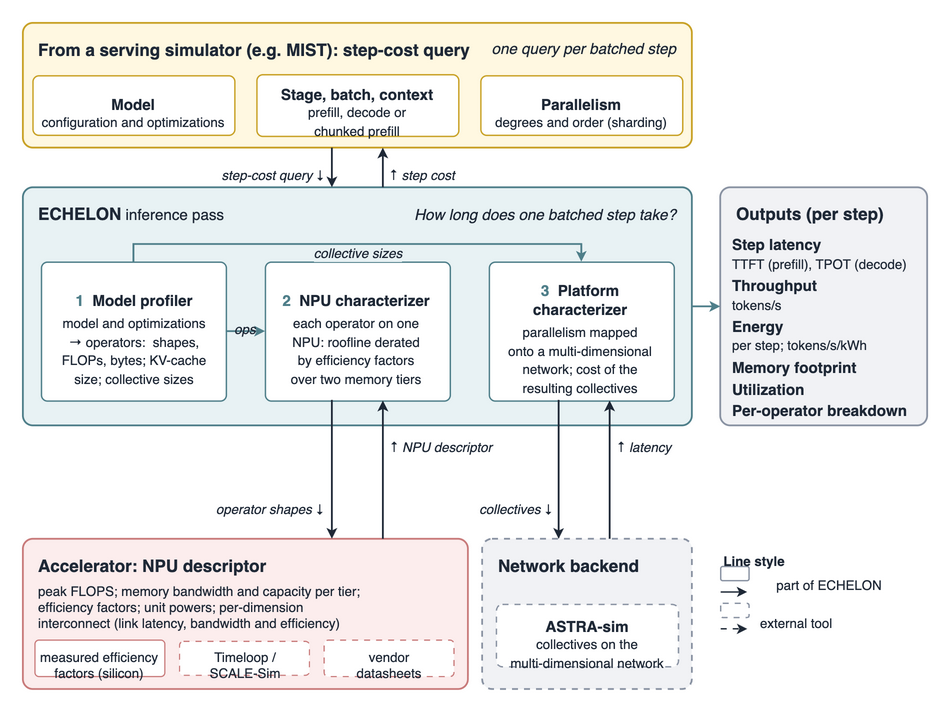
ECHELON has three components:
-
Model profiler. Reads the HuggingFace config and turns the model and its optimizations into operators: shapes, FLOPs, bytes, KV-cache size and collective sizes. Supports MHA/MQA/GQA/MLA attention, dense, GLU, MoE and Mamba models, and optimizations such as FlashAttention, quantization, chunked prefill and speculative decoding.
-
NPU characterizer. Costs each operator on one NPU with a roofline, derated by efficiency factors for compute (
Eff_C) and for two memory tiers (fast HBM/DDR and slow offload memory such as CPU DRAM or CXL):T_op = max(C_op / (FLOPS × Eff_C), M_op / (BW_mem × Eff_mem))For existing hardware, efficiency factors come from measured runtimes. For hypothetical NPUs, they come from microarchitecture simulators such as Timeloop or SCALE-Sim.
-
Platform characterizer. Maps TP, EP, PP and SP onto a multi-dimensional interconnect (each dimension has link latency, bandwidth and efficiency) and costs the resulting collectives, analytically or through ASTRA-sim.
Validation
Against real hardware (NVIDIA A100/H100, Intel Gaudi2, AMD MI300X and SambaNova SN40L), ECHELON's geomean error is at most 5.8%. Prefill and decode error on NVIDIA platforms is below 3%, and chunked-prefill end-to-end error is below 2%. Platform rankings stay the same when the efficiency factors are perturbed by ±30%.
What ECHELON has been used for
- Hardware requirement analysis. How TFLOPS, memory bandwidth, interconnect bandwidth and link latency each affect prefill, decode and chunked latency.
- Cross-technology comparison. Four compute architectures (multi-GPU, SRAM wafer, multi-SRAM-chip, Transformer ASIC) and four interconnect configurations. No architecture wins everywhere: SRAM wafer-scale engines lead for long-context and reasoning workloads, GPUs and ASICs for decode-heavy interactive use, and optically augmented scale-out fabrics are the most balanced for large models.
- Heterogeneous speculative decoding. Drafting on SRAM chips while GPUs verify improves interactivity and GPU utilization over homogeneous deployments.
- Platform requirements for LLM use cases (arXiv 2024, the original GenZ paper).
Installation
pip install genz-llm
The PyPI release lags behind this repository. To build from source (this repo
includes the aiconfigurator submodule, used for the ASTRA-sim backend):
# 1. Install Git LFS (required by the aiconfigurator submodule)
git lfs install

# 2. Clone the repo with submodules
git clone --recurse-submodules https://github.com/astra-sim/GenZ-LLM-Analyzer.git
cd GenZ-LLM-Analyzer

# If you already cloned without --recurse-submodules, initialize it now:
# git submodule update --init --recursive

# 3. Create/activate the conda environment
conda create -n genz_env python=3.10 -y
conda activate genz_env

# 4. Install ECHELON (GenZ) and the aiconfigurator submodule
pip install -r requirements.txt
pip install -e .
pip install -e GenZ/aiconfigurator
Examples
from GenZ import prefill_modeling, decode_modeling

kw = dict(model="meta-llama/meta-llama-3.1-8b", batch_size=8, input_tokens=2048,
          system_name="H100_GPU", bits="bf16", tensor_parallel=1)
ttft = prefill_modeling(**kw)["Latency"]                     # ms
tpot = decode_modeling(**kw, output_tokens=256)["Latency"]   # ms
Predefined NPUs are in Systems/system_configs.py;
pass a dict or a GenZ.NPU instead of a name to describe a new one.
The code uses the paper's terms. Older names (System, GenZ.system,
prefill_moddeling, decode_moddeling, chunked_moddeling,
ModdelingOutput, get_*_parallization*, model_profilling=) still work for
one release and emit a DeprecationWarning (see GenZ/_deprecated.py). The notebooks in
notebook/ cover more:
| Notebook | Shows |
|---|---|
LLM_inference_perf.ipynb | Prefill and decode latency across models and systems |
LLM_memory_analysis.ipynb | Weight and KV-cache memory footprint |
Chunked_prefill.ipynb | Chunked prefill |
LLM_operator_breakdown.ipynb | Per-operator runtime breakdown |
*_moe_model_test.ipynb, moe_load_imbalance_testing.ipynb | MoE models and expert load imbalance |
mamba_model.ipynb | State-space models |
Scale-out-example.ipynb | Multi-dimensional interconnect |
Parallelism and communication
ECHELON supports Tensor (TP), Pipeline (PP), Expert (EP, MoE only) and Sequence
(SP) parallelism. The physical order of the parallelism dimensions is set with
parallelism_hierarchy, e.g. "TP{8}_EP{4}_PP{2}": TP NPUs are the closest,
then EP, then PP. Data parallelism does not change one step's cost and is left
to the caller.
| Collective | Used by |
|---|---|
| AllReduce | TP, EP |
| All-to-All | EP |
| Send-Recv | PP |
| AllGather | SP, TP |
| ReduceScatter | TP |
AllReduce can be split into ReduceScatter followed by AllGather, and collectives can be overlapped with compute or run sequentially.
Data types
Data types are expressed by their number of bits:
| Data Type | Bits |
|---|---|
| FP32 | 32 |
| BF16 | 16 |
| INT8/FP8 | 8 |
| INT4/FP4 | 4 |
| INT2 | 2 |
Use with MIST
ECHELON costs one batched step; it has no request queue or scheduler.
MIST simulates the serving pipeline
around it and calls ECHELON through ClusterConfig for each step when the
target hardware does not exist or the study needs energy.
TODOs
Any contributions or feedback are welcome.
- Support LoRA
- Add different kinds of quantization for weights/KV/activations
Citation
If you use ECHELON, please cite the ICCAD 2026 paper:
@inproceedings{echelon_iccad26,
  title     = {Analyzing the Impact of Emerging Technology on {AI} Datacenter
               Serving Distributed {LLM} Inference using {ECHELON}},
  author    = {Bambhaniya, Abhimanyu Rajeshkumar and Raj, Ritik and
               Jeong, Geonhwa and Kundu, Souvik and Srinivasan, Sudarshan and
               Subramanian, Suvinay and Elavazhagan, Midhilesh and
               Kumar, Madhu and Krishna, Tushar},
  booktitle = {IEEE/ACM International Conference on Computer-Aided Design
               (ICCAD '26)},
  address   = {San Jose, CA, USA},
  year      = {2026},
  doi       = {10.1145/3831252.3834151}
}
The original GenZ paper:
@misc{bambhaniya2024demystifying,
  title         = {Demystifying Platform Requirements for Diverse {LLM}
                   Inference Use Cases},
  author        = {Bambhaniya, Abhimanyu and Raj, Ritik and Jeong, Geonhwa and
                   Kundu, Souvik and Srinivasan, Sudarshan and
                   Elavazhagan, Midhilesh and Kumar, Madhu and Krishna, Tushar},
  year          = {2024},
  eprint        = {2406.01698},
  archivePrefix = {arXiv},
  primaryClass  = {cs.AR}
}