
freesbc
One binary. One YAML. Zero exposed PBX. FreeSBC is a pure-Go SBC that keeps FreeSWITCH/Asterisk off the public internet—SIP proxy, RTP/SRTP relay, WebRTC gateway, and built-in SIP security.
Automatically checked · GitHub checked 2026-11-12
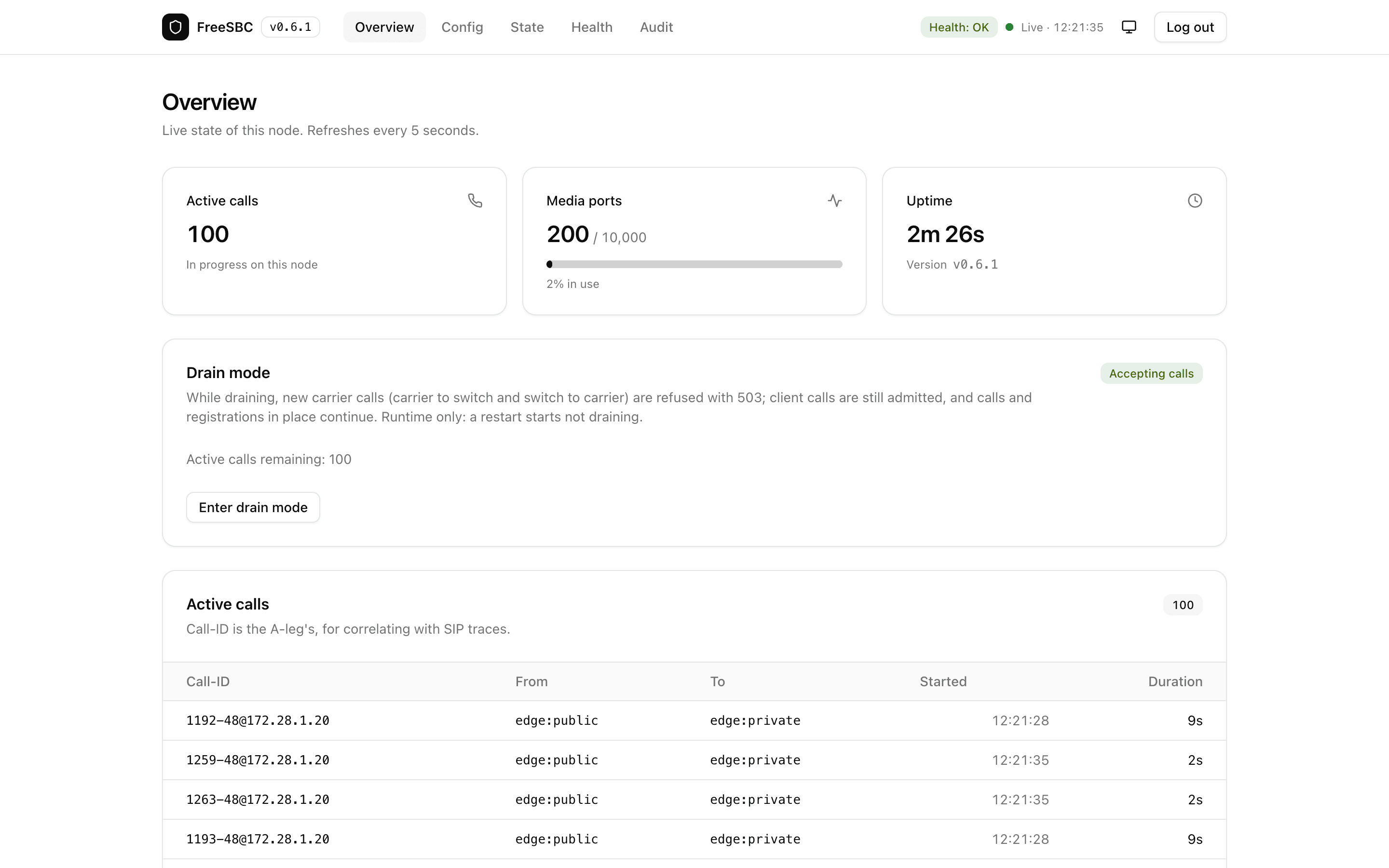
Overview
FreeSBC
An open-source SIP/WebRTC edge proxy with the Caddy experience: one binary, one YAML file, ./freesbc run.


- One static Go binary, nothing else to run: no database, no Redis, no kernel modules, and no external media process.
- Keeps your switch off the public internet: FreeSBC is the only element with a public address; FreeSWITCH or Asterisk stays on a private LAN and only ever talks to FreeSBC.
- Phones, browsers and carriers through one public address: SIP over UDP, TCP and TLS, WebRTC over WS/WSS, and carriers.
- Built for the open internet: per-IP rate limits, scanner fingerprinting, REGISTER brute-force and enumeration bans, and silent drops for calls from unregistered sources.
- Embedded WebUI, REST API and Prometheus metrics behind a bcrypt-checked admin login.

Install
curl -fsSL https://github.com/rasonyang/freesbc/releases/latest/download/install.sh | sh
Linux or macOS, amd64 or arm64. It installs the latest release in /usr/local/bin after checking it against the release's SHA256SUMS (and that file's signature, when cosign is installed). Run as root on a systemd host, it also sets up the freesbc user, /etc/freesbc and the unit (not started), and prints the steps left to start the service (details).
Then write a config and run it:
freesbc init  -c freesbc.yaml    # asks for the switch, detects the addresses
freesbc check -c freesbc.yaml    # validate; errors name the line and key
freesbc check --deploy --local-addresses -c freesbc.yaml   # on the target host: TLS files and addresses
freesbc run   -c freesbc.yaml    # SIGINT/SIGTERM to stop
To read the script before it runs: curl -fsSLo install.sh https://github.com/rasonyang/freesbc/releases/latest/download/install.sh; less install.sh; sh install.sh. Releases sign SHA256SUMS with Sigstore (keyless, through GitHub OIDC); with cosign installed the script checks that signature too, and FREESBC_VERIFY=require makes it mandatory. To check install.sh itself against the signed SHA256SUMS before running it, see Integrity.
Manual download with checksum and signature checks, building from source, the systemd layout and the full freesbc init reference: docs/install.md.
Read before exposing to the public internet:
docs/design.md(topology, security model) anddocs/edge.md(switch-side requirements).
Performance
Measured on one 4 vCPU / 8 GiB cloud VM running FreeSBC v0.5.0, with the load generator and the switch on separate hosts:
- 5000 concurrent calls with media at 80% CPU (373 MB RSS); one vCPU passes a commercial SBC's published 1000-call test.
- 3500 CPS carrier to switch (3250 switch to carrier).
- 8 hour soak at 3500 concurrent calls: 432,000 calls, 0 failed, no growth.
- 19,000 registrations held.
- Under 1 ms of added latency.
Method, all results, sizing and which figures are lower bounds: docs/performance.md; the harness to repeat it: test/perf/.
How it fits together
  Internet ──> FreeSBC  203.0.113.7   public: SIP/UDP/TCP/TLS, WS/WSS, RTP, WebRTC
                  │
                  │ private LAN/VPN: plain SIP/UDP + RTP
                  │ one fixed socket, 10.77.0.2:5060
                  v
              switch (FreeSWITCH / Asterisk)  10.77.0.10   no public IP, no port forward
                  │
                  └── carriers: the switch sends carrier traffic to FreeSBC as its outbound proxy
- Clients. REGISTER goes verbatim to the switch, which is the registrar (FreeSBC holds no credential), and calls to and from clients are proxied with FreeSBC on the path; several switches form a pool hashed per user.
- Carriers. The switch owns carrier accounts and failover and uses FreeSBC as its outbound proxy to carriers listed by IP or DNS (SRV/A/AAAA, cached), with deterministic carrier registration tokens; inbound carrier calls reach the switch's carrier port tagged
X-FreeSBC-Carrier. - Media. Every stream is anchored on FreeSBC ports, with hardened first-packet latching, a silence watchdog and no transcoding; browser legs (ICE-Lite, DTLS-SRTP) are relayed to plain RTP.
- Topology hiding. FreeSBC builds every SDP itself and hides the switch from every public leg, but the Call-ID and NOTIFY and MESSAGE bodies are the switch's own text: see the switch-side requirements.
- Trust. Only the private socket is trusted and exempt from the shield, so keep it unreachable from anywhere else; bans live in memory and FreeSBC touches no kernel firewall state. A host with a single address behind a 1:1 NAT can use one UDP socket for both sides (its port is
edge.listen.udp, so SIP can move off 5060 behind a SIP ALG): the switch is then identified by its source IP, a forged switch source reaching the shared udp socket takes the trusted path and skips the shield, and FreeSBC does not defend against this (Single-IP host behind a 1:1 NAT). A second address for the switch side remains the stronger layout.
Details: docs/edge.md (behaviour, switch-side requirements, limitations) and docs/design.md.
Admin & WebUI
Add an admin block, with a bcrypt hash from freesbc hash-password:
admin:
  listen: 127.0.0.1:8080
  password_hash: "$2a$10$..."   # freesbc hash-password
Then open http://127.0.0.1:8080/ and sign in as admin: live calls, registrations, bans, health and a config validator. Prometheus scrapes /metrics on the same address with Basic Auth.
Keep the listener private: a non-loopback listen needs admin.allow_remote: true, which in turn needs the top-level tls and then serves HTTPS.
Endpoints, drain mode, health conditions, the audit log and pprof: docs/config.md.
Documentation
docs/install.md: install script, manual download, source build, systemd service,freesbc initdocs/config.md: every key, default, validation rule and reload classdocs/edge.md: topology, behaviour, switch-side requirements, scope rule, non-goals, known limitationsdocs/single-ip-carrier.md: ordered go-live checklist for one host behind a 1:1 NAT with a carrier (security group, ALG check, first calls, caps)docs/two-node.md: two independent FreeSBC nodes for failover and rolling restarts (carriers, switch, clients; FreeSWITCH and Asterisk examples)docs/homer.md: mirror SIP signaling to a HOMER collector over HEP (setup, what is mirrored, security notes)docs/performance.md: method, all results, sizing (memory, CPS andGOMEMLIMIT), lower boundsdocs/troubleshooting.md: calls that connect and then drop (call endedreasons, lost ACK, RTP silence, session timers)docs/design.md: the design document, what the code does as implementedexamples/switch/: verified FreeSWITCH and Asterisk configurations for the reference topologyfreesbc.example.yaml: annotated example
Not in scope
FreeSBC does only what is necessary to make one switch on a private LAN safely reachable from the public internet; anything the switch does well, it does not do (scope rule).
No transcoding, not a B2BUA, not a registrar, no clustering (for failover, run two independent nodes: docs/two-node.md), and all state is in memory.
Details: non-goals and known limitations.
Development
go vet ./...
go test ./... -race
The edge suite runs entirely on 127.0.0.1 and passes on macOS and Linux. See CLAUDE.md for per-package test ports and the opt-in FreeSWITCH interop test, and docs/design.md §17 for the package layout and what each package owns.
License
Apache License 2.0. See LICENSE.