
fastapi-react-admin
Admin foundation on FastAPI + React 19 + shadcn/ui — row-level permissions, multi-tab that keeps state, approval workflow, permission-bound AI assistant, open API, S3 resumable uploads; PostgreSQL / SQL Server / MySQL
Automatically checked · GitHub checked 2026-11-17

Overview

fastapi-react-admin
English | 简体中文
A batteries-included admin foundation · FastAPI + React 19 + shadcn/ui
Row-level permissions · multi-tab that keeps state · approval workflow · an AI assistant that can't overreach · S3 storage with resumable uploads · web, desktop and mobile
Live demo · Docs · DeepWiki project guide · Quick start · Features · Releases





🚀 Demo account
admin/123456— a public instance anyone can log into; data may be changed or wiped by other visitors, so don't store anything real.
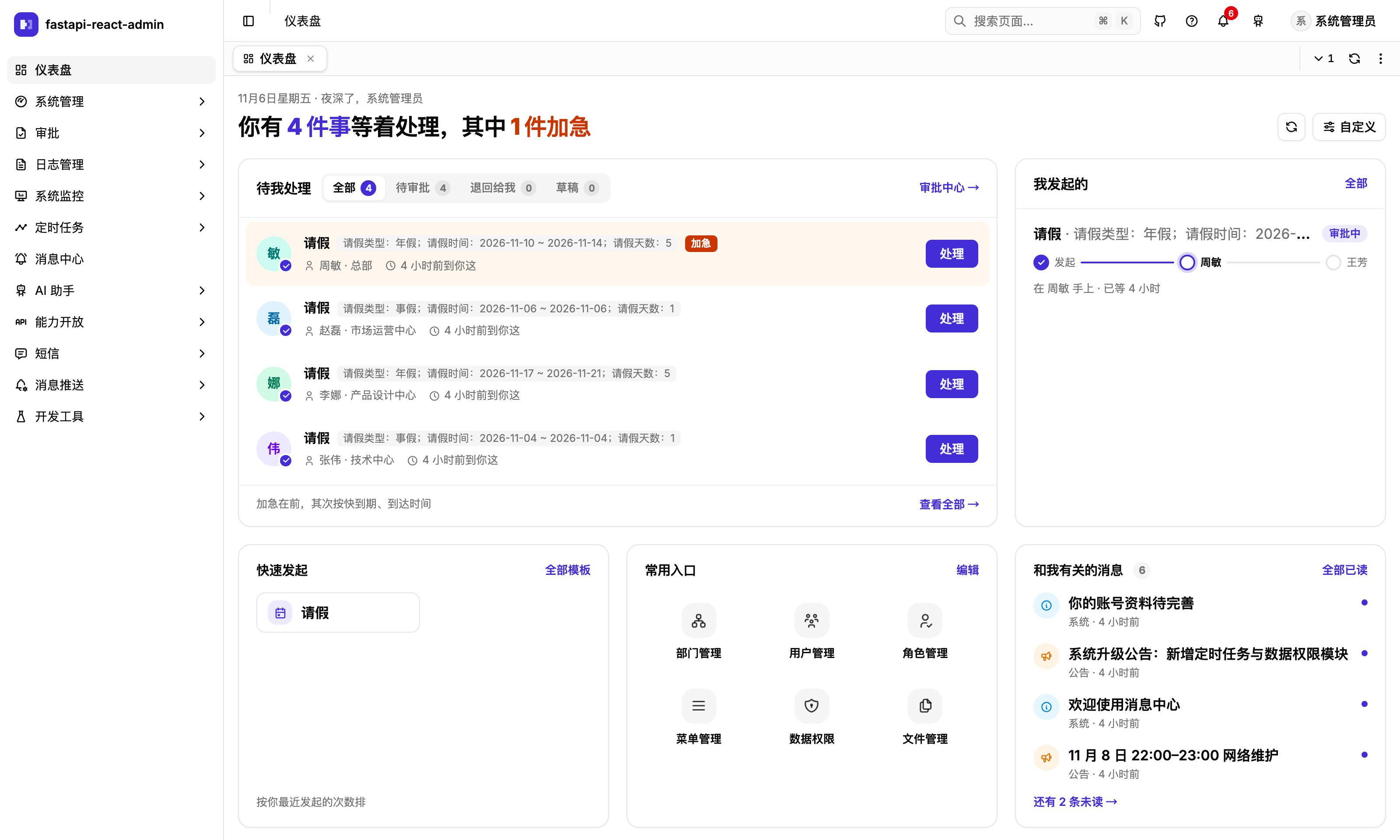 |  |
 |  |
 |  |
🌱 Why build it?
One rewrite, distilled into a base you can start writing business logic on.
AI has made writing code faster, and there are more systems to build because of it: small tools that never made the roadmap are now worth doing, and systems that have run for years are due for a replacement. Yet the first weeks of every new system go to the same list — login, permissions, org structure, approvals, files, notifications.
This project started as a rewrite of a few small Java + Vue 2 systems at work. Rather than patch the old architecture, we rebuilt them on FastAPI + React 19 and distilled everything that gets rebuilt every time into a base. The next system starts with business logic.
One repo for web, desktop and mobile
The backend, the web admin console, a desktop template, a mobile template and the docs site live in one pnpm + turbo monorepo: install once, and one pnpm dev starts backend and frontend.
apps/
├── api        backend · FastAPI + Celery
├── web        web admin console · React 19
├── desktop    desktop template · Electron
├── mobile     mobile template · Expo / React Native
└── docs       docs site · Astro
packages/      one-way deps: i18n / api ← ui ← platform ← web
├── api        frontend/backend type contract, generated from OpenAPI
├── i18n       Chinese / English strings
├── ui         component library, no business logic, portable as a whole
└── platform   permissions, multi-tab, business pages
- The web admin console is the core, ready to use
- The desktop template loads the web build and only adds what a browser can't do: silent printing, local hardware, auto-update
- The mobile template has native screens and shares the API types and translations with web
- The layering is enforced: dependencies flow one way, and
pnpm arch:checkchecks it in CI
Built for working with AI
AI changes code fast, so every change needs something to catch it:
- Tests — 1,600+ tests against a real database and a real browser, no mocks, on every CI run; the E2E report is public
- Types — the frontend/backend contract is generated from OpenAPI; mobile infers every request's types from it, so an API change the screens didn't follow fails type checking (the web client is still migrating, and its call sites currently declare response types by hand)
- Rules written for AI — 50+ per-directory
CLAUDE.md/AGENTS.mdfiles record pitfalls found by testing; a coding assistant reads the one for whatever directory it edits - A backend inside the AI ecosystem — Python + FastAPI, with the built-in AI assistant on pydantic-ai
✨ Why this one
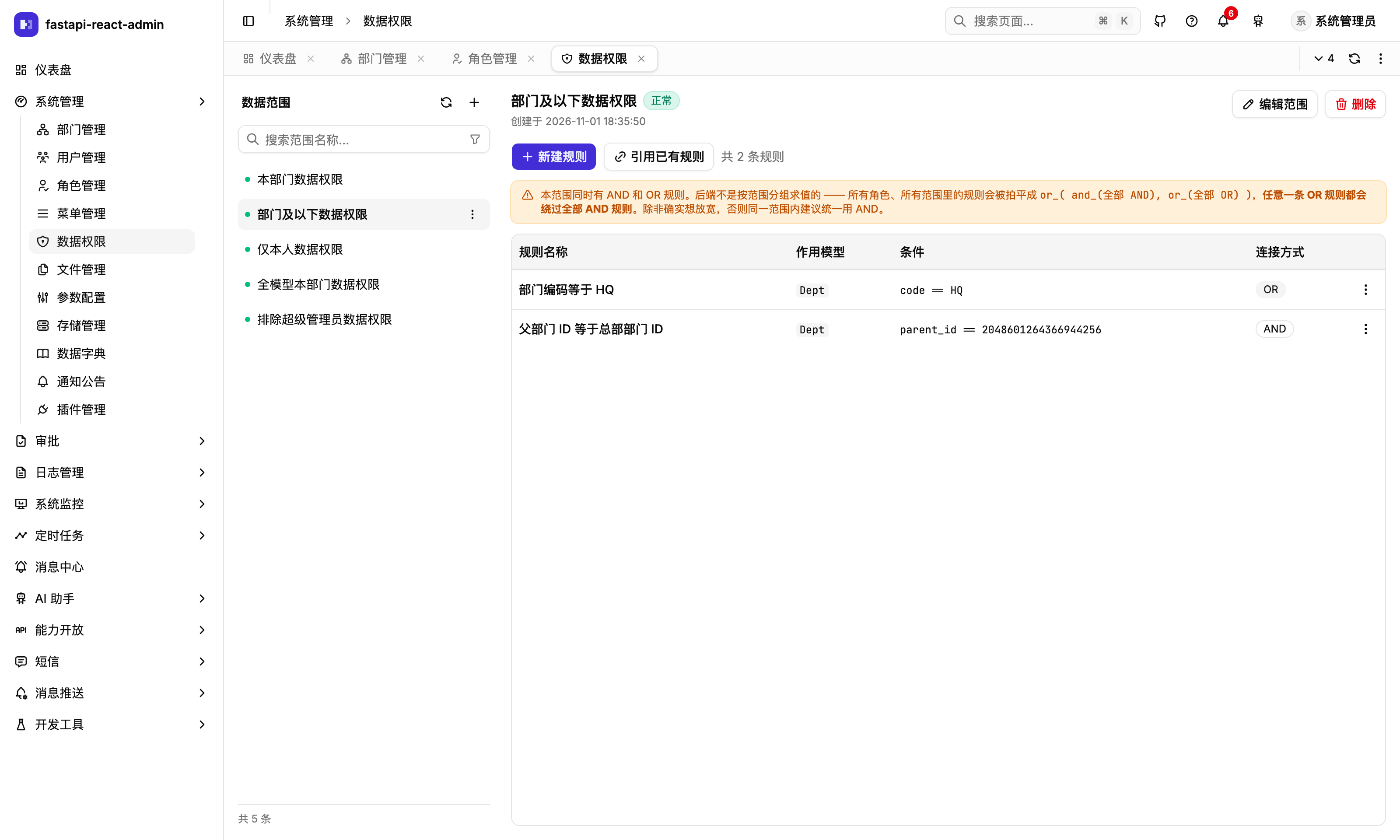
- Permissions down to which rows you see — beyond menus and buttons there are data scopes: on the same user table, a department manager only sees their own department. Rules live on model columns, and the UI warns you when a rule is misconfigured
- Tabs that keep their state — built on React 19's
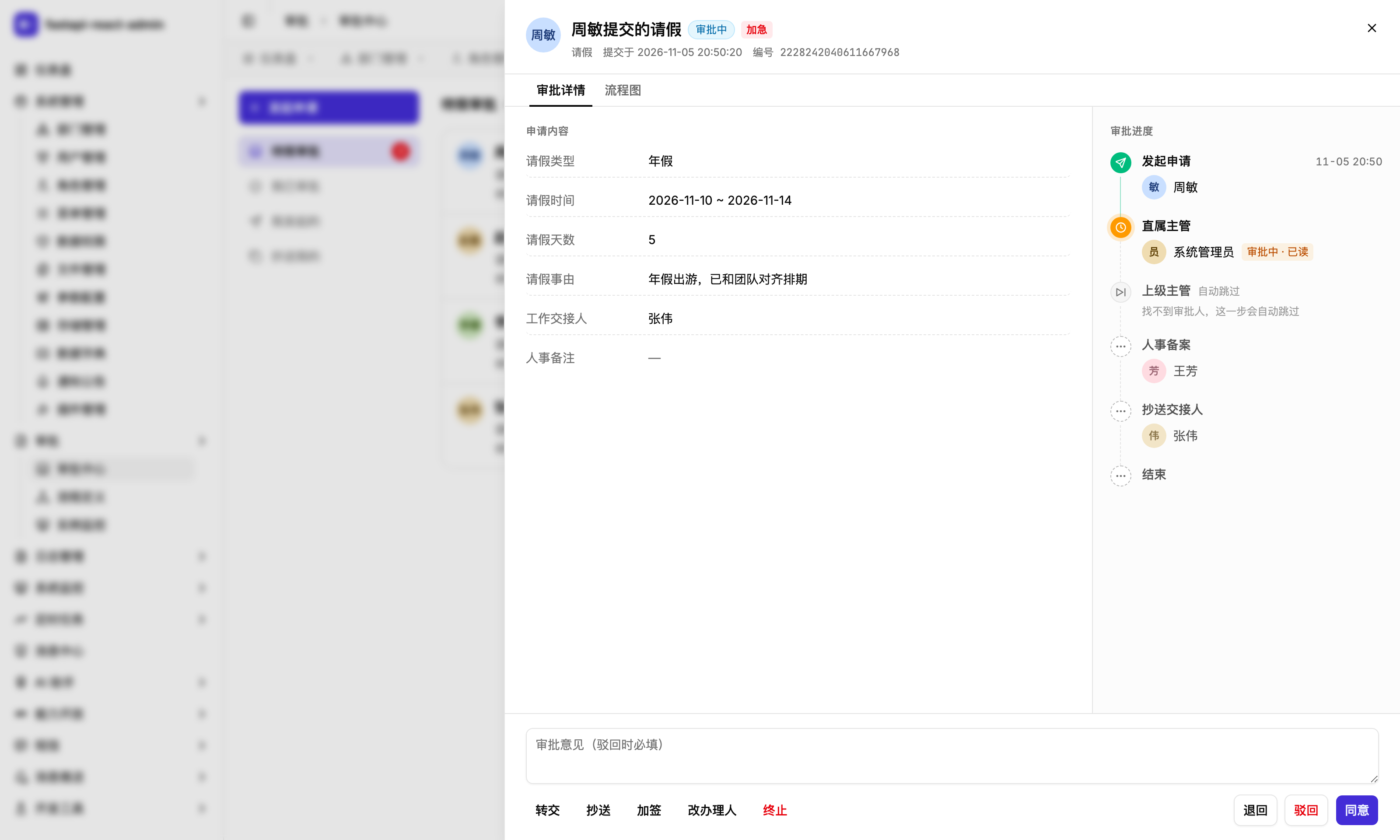
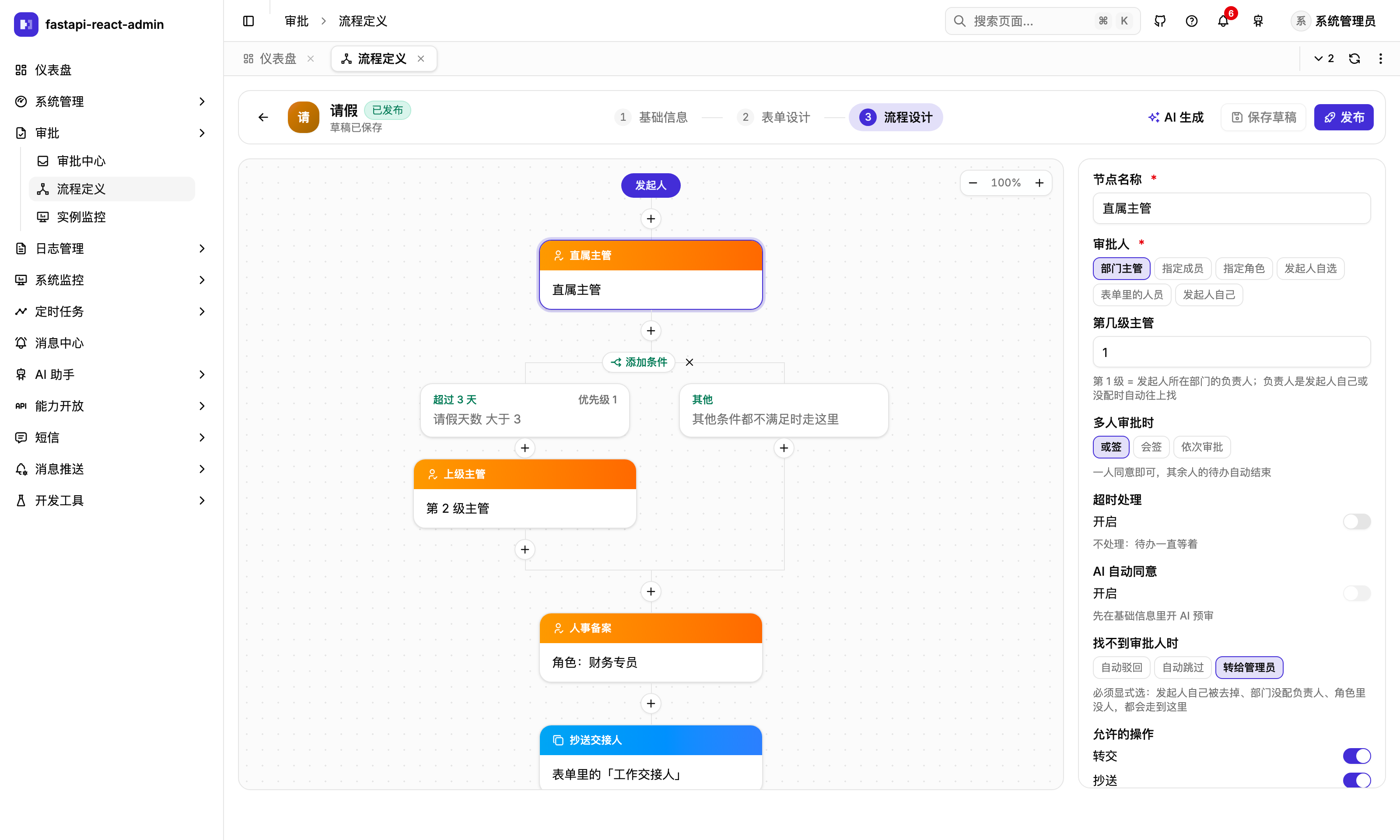
<Activity>: a half-filled form, the page you were on, an expanded tree are all still there when you switch back; view state lives in the URL, so a refresh doesn't lose it either - Approval workflow out of the box — a Feishu-style form designer and flow tree, with or-sign / co-sign, send back, add approvers, take back and timeouts
- An AI assistant that can't overreach — it can do exactly what the signed-in user can do; write actions are previewed and only run after the user confirms, and every call is audited. External systems can reach the same tools through an MCP gateway
- Large files, handled — local disk or S3-compatible storage, instant upload by hash, parallel chunks, resume after a page refresh, and one upload tray for everything in flight
- Pick your database — PostgreSQL, SQL Server or MySQL, same code
- Beyond the browser — an Electron desktop app (installers for three platforms with auto-update) and a native mobile app
- Tested for real — 1,600+ tests against real databases and a real browser; CI runs the full backend suite on both PostgreSQL and SQL Server
How it compares
| Typical template | Here | |
|---|---|---|
| Permission granularity | menus + buttons | menus + buttons + data scopes — the role decides which rows you see |
| Multi-tab | free with Vue's keep-alive; most React templates don't have it, or lose state when you switch away | React 19 <Activity>: open tabs stay mounted, DOM and state survive switching |
| Component base | most are still on shadcn's older Radix version | already on Base UI, shadcn's current default (zero @radix-ui imports), plus a component sandbox you can copy code from |
| Database | usually just one | pick one of three: PostgreSQL (default) · SQL Server · MySQL |
| Business features | users / roles / menus | plus approval workflow, AI assistant, open API, files & storage, messaging and scheduled jobs |
| Tests | mostly none, or component unit tests with mocks | 1,400+ backend + 150+ end-to-end browser tests, against real dependencies, no mocks |
Features
| Area | What you get |
|---|---|
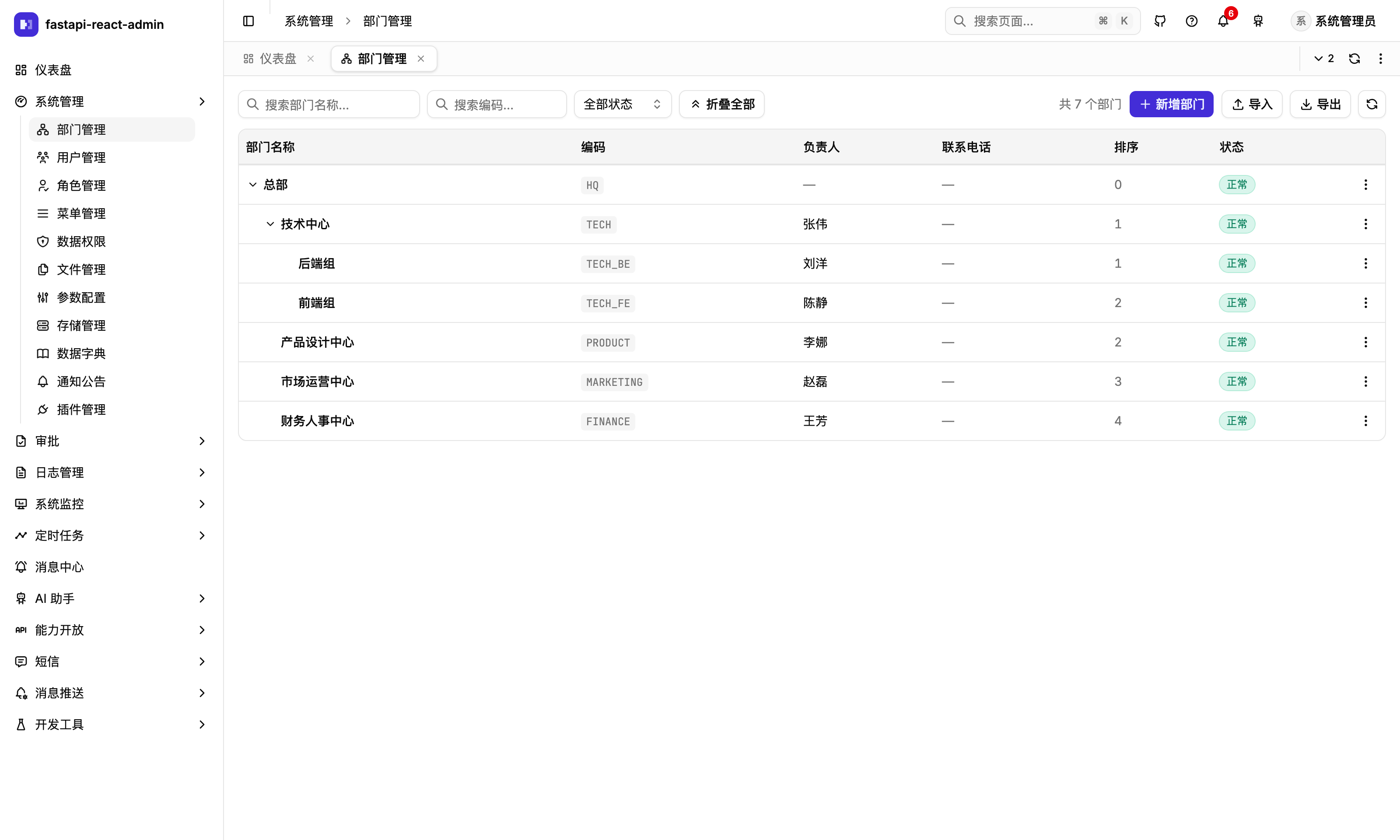
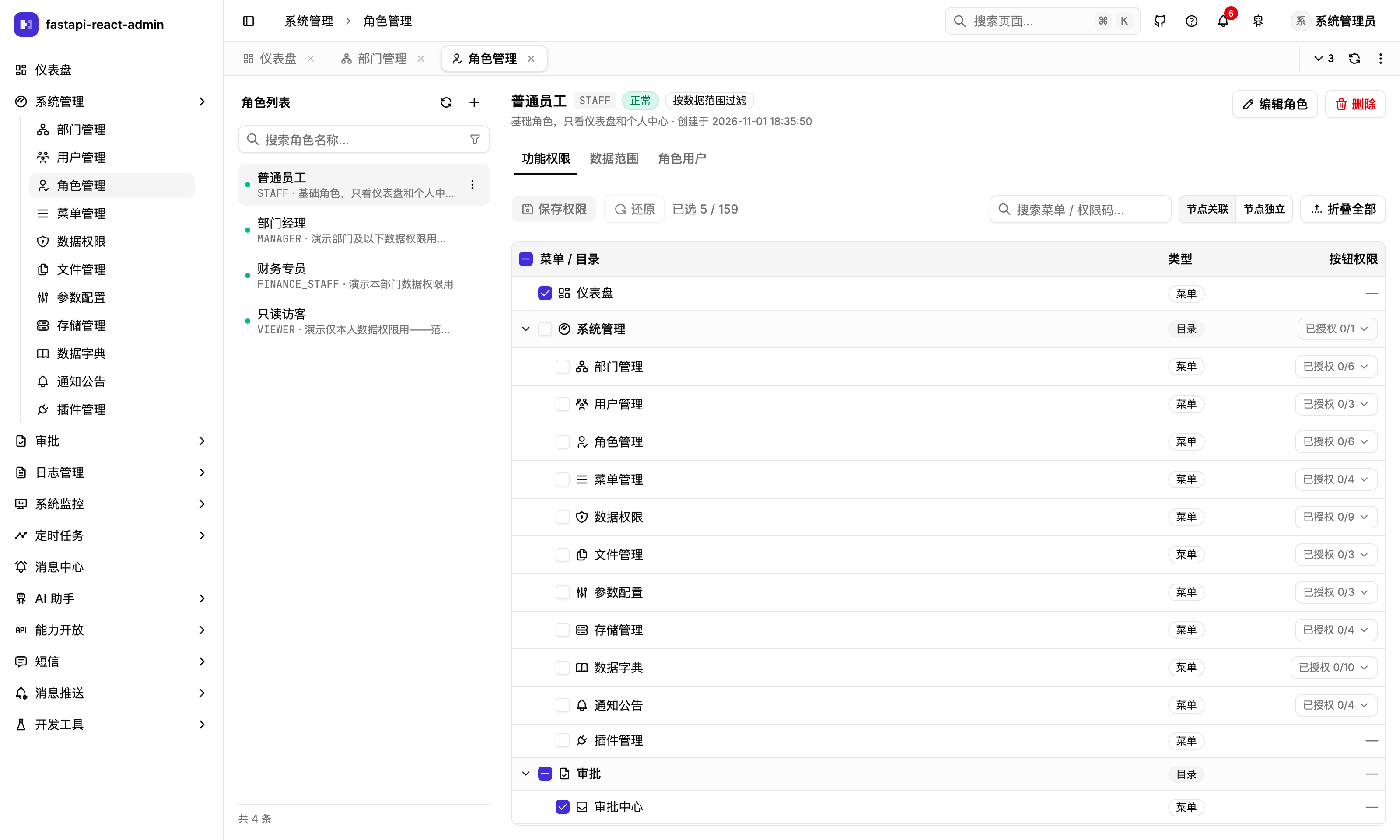
| Access & org | RBAC (menus / buttons / data scopes) · row-level data permissions · department tree · users & roles |
| Import & export | server-side xlsx / csv export (current filter or selected rows · large exports run in the background and notify you when done · formula-injection safe) · generic import (templates with dropdowns · preview & validation · insert only / upsert / update only · error report · all-or-nothing) · build a whole department tree from one file |
| Sign-in & security | captcha · lockout · password history & expiry · SMS code sign-in · two-factor auth (TOTP + recovery codes) · OAuth2 (GitHub / Google) · session management (idle timeout + absolute limit · per-client session caps · tells users why they were signed out · force sign-out) |
| Workspace | customizable dashboard (cards appear by permission · layout saved per user on the server) · multi-tab (pin / drag / reload) · command palette ⌘K · shortcuts · guided tour · theme / radius / tab style · per-user time zone · Chinese & English |
| Files & storage | file manager with previews (pdf / docx / xlsx / images / archives) · local + S3-compatible storage · pre-signed downloads · recycle bin · instant upload · chunked & resumable uploads · attachment panel for any page |
| Approval workflow | form designer · flow tree (approve / CC / conditional branches) · approve / reject / transfer / send back / take back / add approvers · timeout reminders and auto-actions · drafts · urgent · handover · AI pre-review / form filling / AI approval nodes |
| AI assistant | full-page chat + side drawer · tool calls bound by permissions and data scopes · preview + confirm for writes · audit log · MCP gateway |
| Open API | AK/SK-signed endpoints · scopes / IP allow-list / replay protection / rate limits · call logs · incremental sync · Python / Node / Java SDKs · webhook subscriptions (Standard Webhooks signatures · retries · delivery log · bulk resend) |
| Messages & notifications | in-app notifications (real-time) · notices (rich text + attachments · audiences · scheduled publishing · pinned / level / expiry · pop-up after sign-in with required acknowledgement · top banner · sign-in page notices · read stats) · notification routing (email / SMS / Feishu · DingTalk · WeCom group bots · per-event policies · delivery log) · SMS (Alibaba Cloud / Tencent Cloud) |
| Scheduled jobs | online scheduling · cron preview · run history |
| Operations | settings · dictionaries · sign-in / operation logs (redacted) · data change history (who changed which field from what to what, when and from where · linked to the operation log) · server & Redis monitoring · new-version prompt |
| Clients | Electron desktop (installers for three platforms · silent printing · local hardware · auto-update) · native Expo app (not a WebView wrapper; scope below) |
| Developers | component sandbox (every component tweakable and copy-pasteable) · color palette · type-safe API contract generated from OpenAPI |
Stack
| Frontend | React 19 · TypeScript 6 · Vite 8 · TanStack Router / Query / Table v9 · Tailwind CSS 4 · shadcn/ui (Base UI) · zustand · Tiptap 3 · i18next |
| Backend | FastAPI · Pydantic 2 · SQLAlchemy 2 (async) · Alembic · Redis · Celery · Socket.IO · Apache OpenDAL · pydantic-ai |
| Databases | PostgreSQL · SQL Server · MySQL |
| Clients | Electron 42 · Expo 57 / React Native 0.86 |
| Tooling | pnpm + turbo monorepo · uv · ruff · pytest · Playwright · GitHub Actions |
Mobile app
The Expo app covers the things people actually do on a phone (#224); admin-console modules stay on the web. It is versioned separately from the web app.
- Has: home (my approvals · to-do) · approvals (to-do / done / CC'd / started by me · approve / reject / send back / transfer / add signer · start a request · drafts · resubmit after send-back · restart a closed request) · notices · notifications · users · profile (bind a phone number) · server monitoring · time zone · SMS code sign-in · two-factor sign-in · session expiry reasons
- Web only, by design: roles / departments / menus · files · operation & sign-in logs · turning on two-factor auth · AI form filling and AI pre-review in approvals
- Not yet verified: no automated tests (#137), most screens only run on an emulator, no release pipeline
Databases
Switch with DATABASE_TYPE in .env — same code, same migration chain, seed data for all three.
| Good for | How it's verified | |
|---|---|---|
| PostgreSQL (default) | new projects; docker compose up gives you one | full backend suite on every CI run |
| SQL Server | teams already on the Microsoft stack | full backend suite + browser E2E on every CI run |
| MySQL | teams already running MySQL | not in CI; full suite run locally on demand — last run (2026-10-31) passed in full, including an upgrade from v0.0.1 |
Quick start
You need Node ≥ 22.13, Python ≥ 3.11, uv and Docker.
docker compose -f docker-compose.dev.yml up -d          # PostgreSQL + Redis
pnpm install:all                                        # frontend + backend dependencies
cp apps/api/backend/.env.example apps/api/backend/.env  # defaults match the containers above
pnpm db:init                                            # create tables + seed data (first run)
pnpm dev                                                # open http://127.0.0.1:8888
Sign in as admin with the password you set during pnpm db:init. Switching to SQL Server / MySQL, S3, skipping the captcha and running tests are covered in CONTRIBUTING.md (Chinese; the commands are language-independent).
Quality
1,400+ backend pytest tests run against a real database and Redis; 150+ Playwright tests drive a real browser against the real API and database — no mocks.
Data permissions were verified by signing in as 41 real accounts one by one; key safeguards are mutation-tested (break the code on purpose, confirm the tests go red).
The E2E report from every main run is public, with screenshots and videos of failures.
Docs
| To… | Read |
|---|---|
| get started step by step: quick start, deployment, your first module, FAQ, upgrading | docs site |
| develop locally, run tests, open a PR, release | CONTRIBUTING.md |
| learn the engineering rules and pitfalls | CLAUDE.md — task-indexed, 40+ module notes, every claim backed by a test or measurement |
| deploy to a server | deploy/README.md |
| desktop app | apps/desktop/README.md |
| integrate with the open API | apps/api/backend/plugin/open/README.md |
| reuse the component library | packages/ui/PORTING.md |
| security notes | SECURITY.md |
License
Acknowledgements
The backend was originally built on fastapi-best-architecture (FBA) — its three-layer structure, plugin system and RBAC / data-scope model come from FBA's design. Thanks to its author and contributors 🙏 FBA is also MIT-licensed; its original copyright notice is kept in apps/api/LICENSE. Thanks also to shadcn/ui, TanStack, Tiptap, file-viewer and the other open-source projects this is built on.