
b4
Network packet processor with a friendly UI for circumventing Deep Packet Inspection (DPI) systems.
Automatically checked · GitHub checked 2026-11-13
Overview
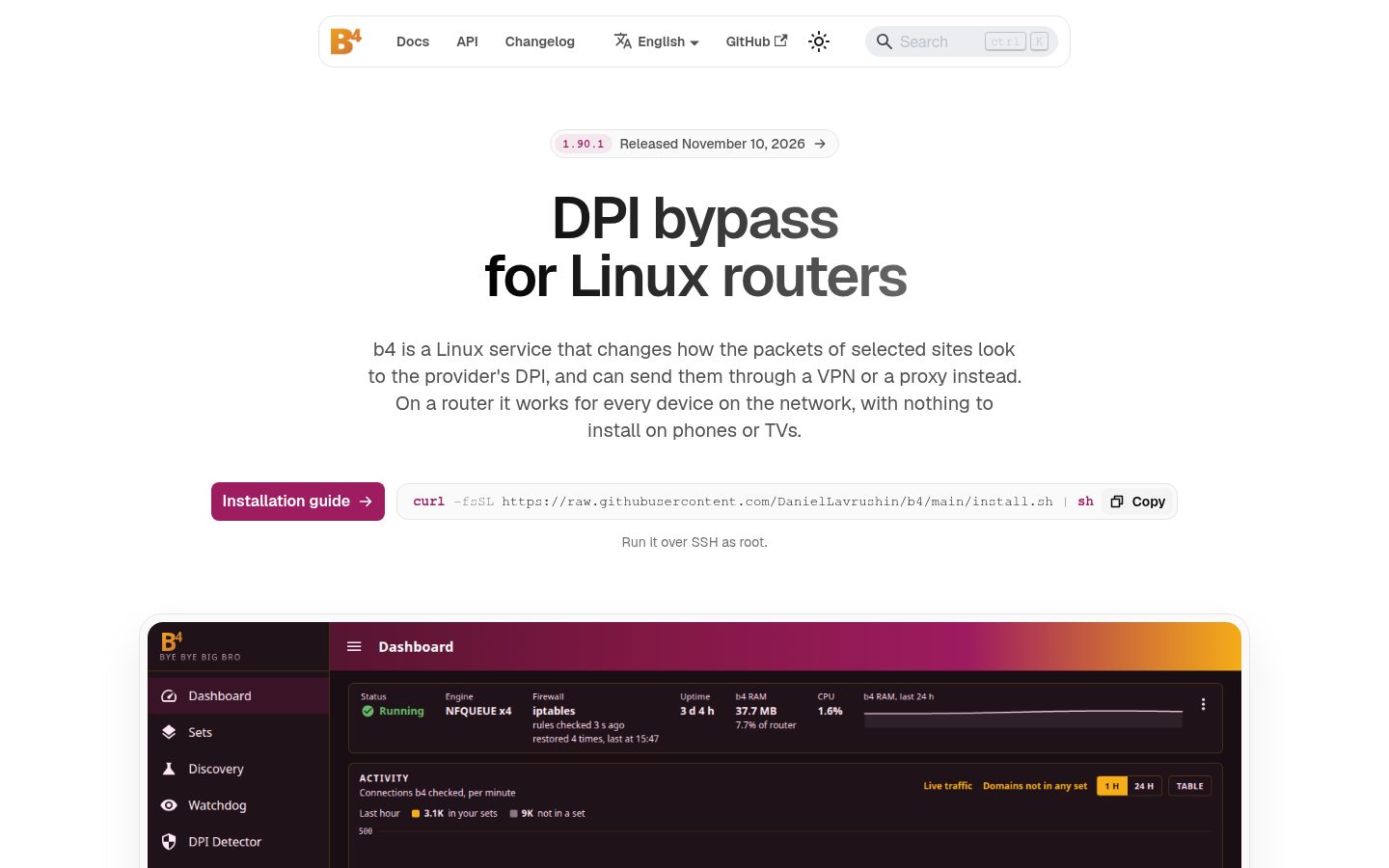
B4 (Bye Bye Big Bro) is a Linux service that bypasses DPI-based blocking. It runs on routers, servers and desktops and rewrites packets so DPI equipment cannot classify the connection, while the destination server still gets valid data. Installed on a router, it covers every device on the network with nothing configured on the clients. Configuration is built from sets. A set is a list of targets (domains, IPs/CIDRs, geosite/geoip categories, ports, LAN devices) plus the bypass techniques, DNS handling and routing applied to them. Sets are edited in the built-in web UI on port 7000 and applied to the running service without a restart. If you don't know which technique your provider needs, Discovery tests strategies against your own connection and saves the working one as a set. The Watchdog re-runs it when a site breaks. - Ten fragmentation strategies: combo, hybrid, tcp, ip, tls, oob, disorder, extsplit, firstbyte, none, plus a random strategy pool - Fake packet injection: decoy ClientHellos, TCP desync bursts, window manipulation, fake SYN, SACK stripping, ClientHello mutation - RST protection - detects forged resets by TTL/flag/option fingerprint and drops them - DNS: per-set redirect to a plain resolver or DoH, hosts-style pins, fragmented queries, DNS-over-TCP interception, healing of answers pointing at dead addresses - Routing: send a set's traffic out a chosen interface (VPN, WireGuard, second WAN), through an upstream SOCKS5 proxy, or block it - Block mode for network-wide ad and tracker blocking - Telegram: built-in MTProto proxy, plus a transparent Telegram-over-WebSocket bridge for stock clients - Discovery finds a working strategy, Watchdog re-heals broken domains, DPI Detector reports what the provider is doing - Escalation chains: when a set stops working for a host, that host moves to a heavier backup set - Per-device rules by MAC - Works on both iptables and nftables, picking the backend automatically, and handles IPv4 and IPv6 - Web UI in English and Russian - iptables or nft, plus ip. ipset is needed for routing features on iptables-only systems 2. On a successful result click Use this configuration, then Create a new set.