
Athena-Public
Turn stateless LLMs into a stateful, compounding AI agent. Local-first persistent memory, quantitative decision screens, and governance harness across Claude Code, Antigravity, Cursor, and VS Code. Own the state. Rent the intelligence.
Automatically checked · GitHub checked 2026-11-16
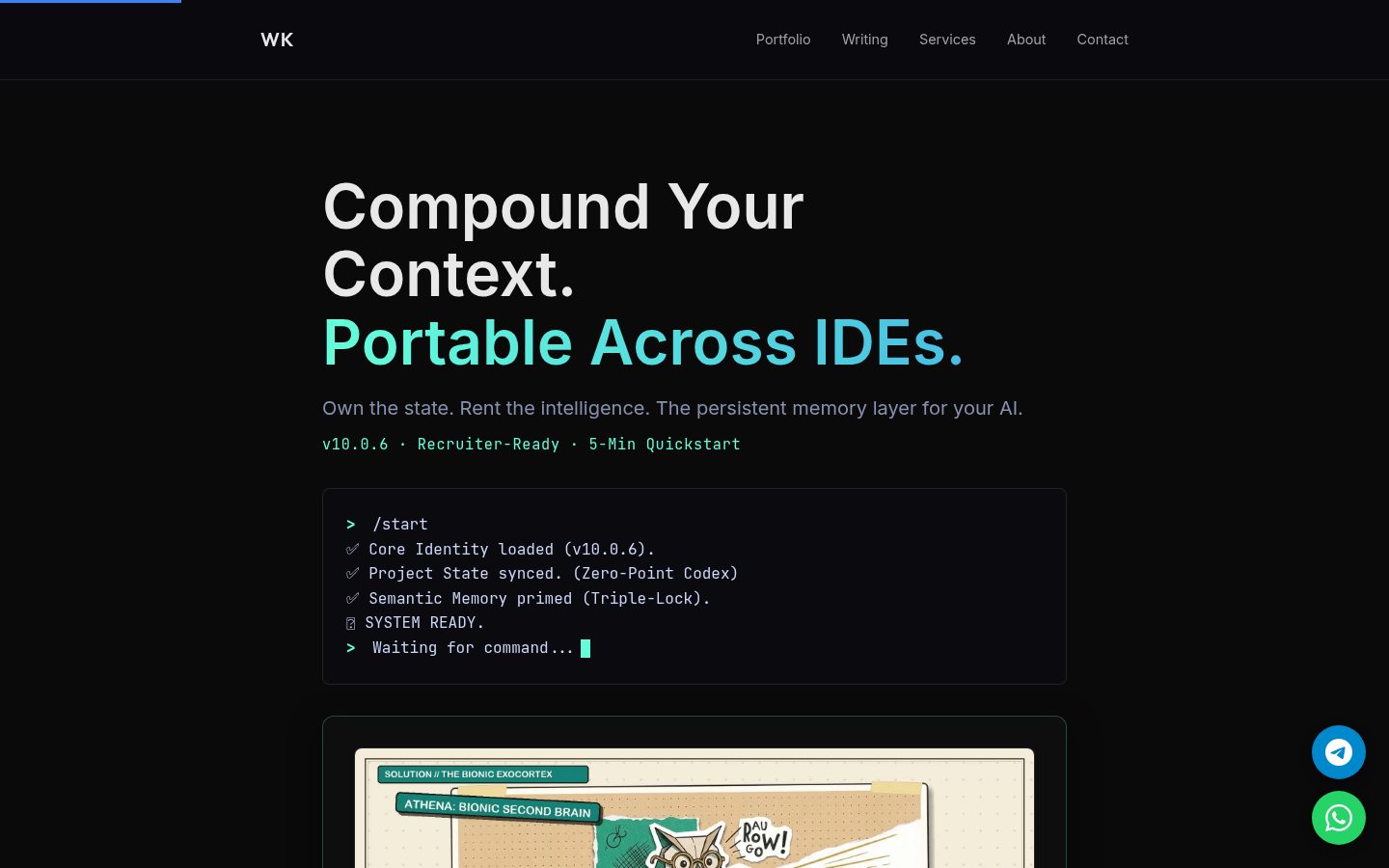
Overview
Athena
Local-first memory, decision engine, and governance harness for AI agents — portable across any IDE.
Own the state. Rent the intelligence. Persistent memory, structured reasoning, and governed AI agents that work across any LLM — stored as plain Markdown and JSONL on your disk across Claude Code, Antigravity, Cursor, Gemini CLI, and VS Code.


Quickstart · How It Works · Structure · SDK & MCP Tools · Docs · Why Athena? · Safety
The Problem: Stateless AI is an Amnesiac Bottleneck
Why do AI coding assistants still give generic, textbook answers? Because frontier LLMs are fundamentally stateless.
Every time you open a new session, the model starts from zero. It has no memory of your architecture, your past post-mortems, your risk tolerance, or your code invariants. To get useful work done, you are forced to pay an Amnesia Tax — spending 10 minutes writing prompt essays explaining your stack and constraints. Worse, platform memory is designed to agree with you faster (sycophancy), not to stress-test your assumptions when stakes are high.
Athena solves this by separating intelligence (the rented model) from state (your sovereign disk):
| Dimension | Stateless Chatbots (Rented RAM) | Stateful Agent with Athena (Owned Hard Drive) |
|---|---|---|
| Memory & Context | Amnesiac: starts from zero; 10-minute prompt prep tax | Continuous: /start restores active tasks & invariants in ~3.6K tokens and <1s via batched boot_status.py |
| Response Depth | Generic median: broad consensus advice & textbook platitudes | Hyper-nuanced: conditioned on your real stack, balance sheet, & past post-mortems |
| Alignment & Rigor | Sycophantic: agrees with whatever you say, validating bad ideas | Governed: Law #1 blocks ruin; consigliere flags repeated blind spots |
| Data Sovereignty | Vendor lock-in: cloud database fees, wiped on API deprecation | 100% Sovereign: local Git-tracked Markdown & SQLite on your machine |
| Model Agility | Trapped in one chat platform | Portable: switch between Claude Code, Antigravity, Gemini, or Ollama instantly |
Athena moves the memory, problem-framing, and decision layer to your machine: plain Markdown and JSONL ledgers that you own, git-version, and mount into any IDE. The model is just whoever's on shift.
Quickstart
git clone https://github.com/winstonkoh87/Athena-Public.git && cd Athena-Public
python3 -m venv .venv && source .venv/bin/activate
pip install -e ".[local]"               # lightweight — no cloud deps
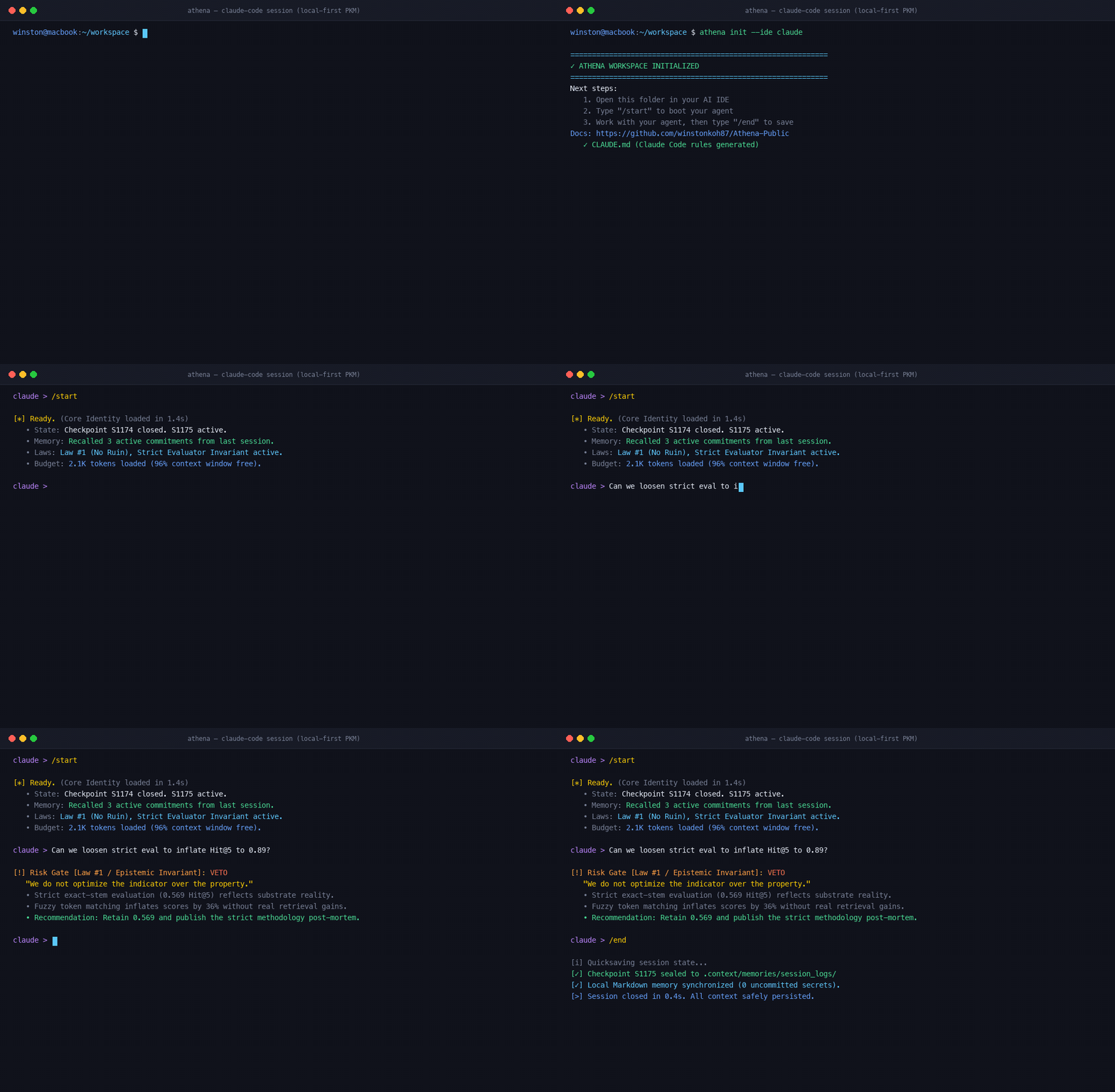
athena init --ide claude                # or: antigravity, cursor, gemini, vscode, kilocode, roocode
athena doctor                           # expect 0 failures
Then type /start in your IDE's AI chat panel. Work normally. Type /end to save.
Full install (cloud sync + cross-encoder reranking):
pip install -e ".[full]"See Getting Started for Windows, advanced config, and Supabase setup.
How It Works
┌─────────────────────────────────────────────────────────────────────────┐
│  Your IDE (Claude Code / Antigravity / Cursor / Gemini / VS Code)       │
└───────────────────────────────┬─────────────────────────────────────────┘
                                │ MCP Servers (19 Athena + 5 DuckDB tools) + Hooks
                                ▼
┌─────────────────────────────────────────────────────────────────────────┐
│  Athena SDK (src/athena/)                                               │
│  ├── 1. Memory & Hybrid RAG: /start (~3.6K boot), 5-channel parallel    │
│  │      RRF search, speculative "auto" local+ONNX fast-path, SQLite     │
│  │      search_cache_vecs.db                                            │
│  ├── 2. Problem Framing: VOI (EVI) calculator, falsifier & R1-R13       │
│  │      commitment gates (frame_ledger.py)                              │
│  ├── 3. Decision, Wargaming & OSINT: EEV, 1/3 Kelly, Ruin, MCDA         │
│  │      (gto_engine.py), 2-turn Wargame (wargame.py), UCDS OSINT        │
│  │      (ucds_validator.py)                                             │
│  └── 4. Governance & Telemetry: Lambda risk router, Law #1 ruin blocker,│
│         Trade Guardian (trade_guardian.py), O(1) 64KB JSONL tail gates  │
│         (jsonl_tail.py)                                                 │
└───────────────────────────────┬─────────────────────────────────────────┘
                                │
                                ▼
┌─────────────────────────────────────────────────────────────────────────┐
│  Your Disk (Plain Markdown + SQLite/JSONL receipts — git-native)        │
│  └── Optional: Supabase pgvector (cloud sync) + DuckDB (analytics)      │
└─────────────────────────────────────────────────────────────────────────┘
Three operating modes, one compounding loop:
| Mode | Lifecycle | Token Budget | Retrieval & Compute Strategy |
|---|---|---|---|
Sniper (SNIPER, Lambda < 10) | Direct chat -> /end | ~500 tokens | vector_mode="local" (<50 ms local FTS5/lex/canonical, zero cloud RTT) |
MinMax v2.0 (Default) (STANDARD, Lambda 10–30) | /start -> work -> /end | ~3.6K boot tokens (14.5 KB, -78.1%) | <1.0s concurrent scripts/boot_status.py; speculative "auto" local+ONNX fast-path (Lambda 10–14) escalating to "always" hybrid vector+rerank (Lambda >= 15) |
MaxMax v4.0 (Curated Compute) (ULTRA, Lambda > 30) | /ultrastart -> /ultrathink -> /ultraend | <= 40K boot ceiling (< 20% of 200K ECL) | Surgical canonical/project slice loading (~145K+ tokens reserved for multi-track synthesis), 3-query parallel adversarial Exocortex pre-warming, and 3-mode /ultrathink orchestration (Native Swarm / API / HITL) |
Repository Structure
Following Protocol 543 clean-lobby repository layout:
Athena-Public/
├── src/athena/          # Core runtime (Memory, Intelligence/GTO, Governance, Lifecycle, Tools)
├── tests/               # Test suites (unit, integration, red-team, MinMax/MaxMax regression)
├── scripts/             # Batched boot, shutdown hygiene, benchmarks, and sync verification
├── docs/                # Architecture, guides, wiki mirror, roadmap, benchmarks, and specs
├── examples/            # Reference workflows, skills, protocols, scripts, templates, and demos/
├── supabase/            # Database schemas, migrations, edge functions, and vector RPCs
├── docker/              # Sandboxed container environments
├── data/                # Active datasets and public asset staging
├── .agent/              # Shipped agent workflows, hooks, scripts, and canonical config
├── .context/            # Workspace state templates, protocol summaries, and canonical view
├── .framework/          # Reference framework modules and legacy compatibility specs
├── .github/             # Workflows, CI scripts, security/contributing/support/CoC policies
├── AGENTS.md            # Root agent entrypoint (symlinked by CLAUDE.md)
├── ARCHITECTURE.md      # Narrative system architecture and memory layout
├── DATA_CONTRACT.md     # Authoritative read/write boundary specification
├── SAFETY.md            # Risk boundaries and crisis/harm safeguards
├── CHANGELOG.md         # Root pointer to docs/CHANGELOG.md
├── athena.yaml          # Machine-readable agent capability manifest
├── llms.txt             # LLM-friendly index of public docs and specs
├── pyproject.toml       # Package metadata, dependencies, and tool configuration
├── Makefile             # Standard task runner (install, test, lint, typecheck, privacy-check)
├── LICENSE              # MIT License
└── README.md            # Project front door
What Ships in the SDK
Athena is not just a prompt pack — it ships executable Python engines and two Model Context Protocol (MCP) servers (athena.mcp_server and athena.duckdb_mcp_server):
| Subsystem | Module / MCP Tool | What It Computes / Enforces |
|---|---|---|
| Hybrid RAG & Speculative Context Gate | mcp_server.py (smart_search, context_gate), tools/search.py, core/cache.py | Concurrent 5-channel RRF fusion (BM25 FTS5 + pgvector + filename headers + canonical/graph + ONNX cross-encoder rerank), "local"/"auto"/"always" vector routing, and zero-write-on-hit SQLite search_cache_vecs.db |
| Problem Framing & VOI Ledger | intelligence/frame_ledger.py (frame_open, frame_validate, frame_resolve, frame_status) | Value of Information (EVI) stop-rule, falsifiable hypothesis pre-registration, R1–R13 commitment gates (loop budget, surviving contingency branch, irreversible ruin check), LUCK outcome-band gate, and Brier calibration scoring |
| Quantitative Decision Engine | intelligence/gto_engine.py (decision_screen) | Deterministic evaluators for Expected Economic Value (eev), One-Third Kelly (kelly), Absorbing-Barrier Ruin (ruin), MCDA with ruin vetoes (mcda), Decision Monte Carlo (decision-mc), Scenario Robustness (robustness), Barbell (barbell), and SHA-256 receipts (.athena/decision_receipts.jsonl) |
| Adversarial Wargaming Engine | intelligence/wargame.py (athena-wargame) | Two-turn sequential Blue vs. Red game trees with intra-turn path-dependent trough ruin, Red best-response optimization, and tamper-evident run receipts (.athena/wargame_runs.jsonl) |
| Counterparty OSINT & Trade Governance | intelligence/ucds_validator.py, tools/trade_guardian.py | Deterministic Universal Counterparty Dossier Standard (audit_ucds_dossier) validator (Track A/B bifurcation, knockout gates, cashflow inversion) plus position/drawdown/sizing safety guards |
| Local Analytical SQL | duckdb_mcp_server.py (query, profile, list_tables, export_result) | Zero-dependency DuckDB engine for profiling and querying large CSV, JSON, and Parquet datasets without exhausting LLM context windows |
| Runtime Governance & Batched Telemetry | core/governance.py, scripts/boot_status.py, .agent/scripts/hook_*.py, .agent/scripts/lib/jsonl_tail.py | Concurrent <1.0s boot status, O(1) 64KB EOF tail verification gates, capability permissions, Protocol 509 crisis safety screen, 14/16 destructive command blocker, and secret egress scanner |
What's enforced in code vs. by prompt
Most AI-agent READMEs state every claim in the same confident voice. This one doesn't.
| Claim | Status | Evidence |
|---|---|---|
| Storage & hybrid retrieval — memories stored and surfaced when relevant | ✅ Shipped (code-enforced) | Hybrid RAG with document-level RRF + cross-encoder rerank, hardened through logged regressions |
| Portability — Markdown and JSONL on your disk, movable across models | ✅ Shipped (structural) | Plain files on disk — inspect the repo |
| Quantitative decision screening & wargaming — EEV, 1/3 Kelly, Ruin, MCDA, 2-turn game trees | ✅ Shipped (code-available) | gto_engine.py & wargame.py emit SHA-256 receipts (107 tests); Stop hook blocks unreceipted numeric engine claims |
Pre-registered problem framing — VOI stop-rule, R1–R13 commitment & falsifier gates | ✅ Shipped (code-available) | frame_ledger.py validates falsifiers, loop budgets, and Brier calibration (57 tests) |
| Governed autonomy — hooks block destructive commands, ungrounded claims, and secrets | ✅ Shipped (partial) | Ruin check blocks 14/16 destructive commands; 2 shell bypasses are known and tracked |
| Compounding personalization — session 2,000 recalls session 5 | 🟡 N=1 evidence | 2,100+ sessions, 410 active protocols, and 631 case studies by the author; no multi-user study |
| Anti-sycophancy — personalization doesn't silently increase agreement | 🟡 Partial mitigation | Code-enforced meta-awareness gate (Claude Code hook); agent-discretion in hookless IDEs — see honest limits |
Why publish this table? Because the failure mode of this product category is self-mythologizing — describing aspirations in the present tense. Athena's own convention (Epistemic Status) requires labeling every mechanism as
code-enforced,code-available,agent-discretion, oraspirational. This table is that convention applied to the README.
Measured, Not Claimed
# Run the batched boot status check (<1.0s concurrent telemetry + index health)
python3 scripts/boot_status.py --json

# Run the test suite (including frame_ledger, gto_engine, and MinMax/MaxMax suites)
pytest tests/ -v --tb=short

# Screen a decision quantitatively (EEV / 1/3 Kelly / Ruin / MCDA / Monte Carlo)
python -m athena.intelligence.gto_engine --action mcda --help

# Adjudicate a 2-turn adversarial wargame with path-dependent trough ruin screening
python -m athena.intelligence.wargame --help

# Validate a pre-registered problem frame against R1-R13 commitment gates
python -m athena.intelligence.frame_ledger calibrate

# Run the local KV cache & TTFT benchmark (Ollama / llama.cpp)
python scripts/benchmark_kv_cache.py --model qwen2.5-coder:14b

# Run the retrieval evaluator yourself (requires Supabase keys + golden_queries.json)
python examples/scripts/evaluator.py --k 5 --rerank
| Metric | Value | Verification Command |
|---|---|---|
| MinMax v2.0 Boot & Warm Gate Latency | < 1.0s boot status / < 10 ms warm context_gate hit | pytest tests/test_minmax_remediation.py -v |
| Local TTFT Scaling (2K Boot) | ~35x–50x speedup vs 32K | python scripts/benchmark_kv_cache.py |
| Retrieval Hit@5 (Strict) | 0.569 (37 / 65) | python examples/scripts/evaluator.py |
| Retrieval MRR@5 (Strict) | 0.472 | python examples/scripts/evaluator.py |
| Retrieval Hit@5 (Lenient) | 0.892 (deprecated) | Partial substring match (inflated) |
| Unit & Red-Team Tests | 750+ passed (100%) | pytest tests/ |
| Secret Leaks (1,248+ commits) | 0 detected | Gitleaks + privacy_scan.py in CI |
| Code Quality & Lints | 0 ruff findings | ruff check src/ scripts/ tests/ |
Anti-Goodhart Invariant: Why did our reported Hit@5 shift from 0.89 to 0.57? Lenient substring matchers count partial word overlaps as "hits," inflating benchmark scores by ~36% without improving retrieval. We killed the lenient matcher because vanity metrics mask regressions. See the full breakdown: Anti-Goodhart Benchmarking in RAG.
Agent Compatibility
| IDE | Config file | Tested |
|---|---|---|
| Claude Code | CLAUDE.md | ✅ |
| Antigravity | AGENTS.md | ✅ |
| Cursor | .cursor/rules.md | ✅ |
| Gemini CLI | .gemini/AGENTS.md | ✅ |
| VS Code + Copilot | .vscode/settings.json | ✅ |
| Kilo Code | .kilocode/rules/athena.md | ✅ |
| Roo Code | .roo/rules/athena.md | ✅ |
Documentation
| Doc | What it covers |
|---|---|
| Getting Started | Install, configure, first session |
| Your First Session | 20-minute guided tutorial |
| How It Works | 4-pillar architecture, search pipeline, and decision gates |
| Why Athena? | Philosophy, problem classification, use cases, cost analysis |
| Engineering Depth | Technical deep dives and honest limits |
| CLI Reference | All commands |
| FAQ | Common questions |
| Safety | Limitations and responsible use |
| Changelog | Release history |
Contributing
PRs welcome. Please read CONTRIBUTING.md first.
The codebase uses ruff for linting, pytest for tests, and CI must pass before merge (make check-all).
MIT License · Contributing · Safety · Security Policy · Security Model · Code of Conduct · Support · Accessibility
Built and battle-tested solo across 2,100+ sessions by Winston Koh.
Clone it. Boot it. Make it yours.