
aiworkdeck
Programmers have long had their IDE: files, editing, search, versions and AI in one window.
Automatically checked · GitHub checked 2026-11-12
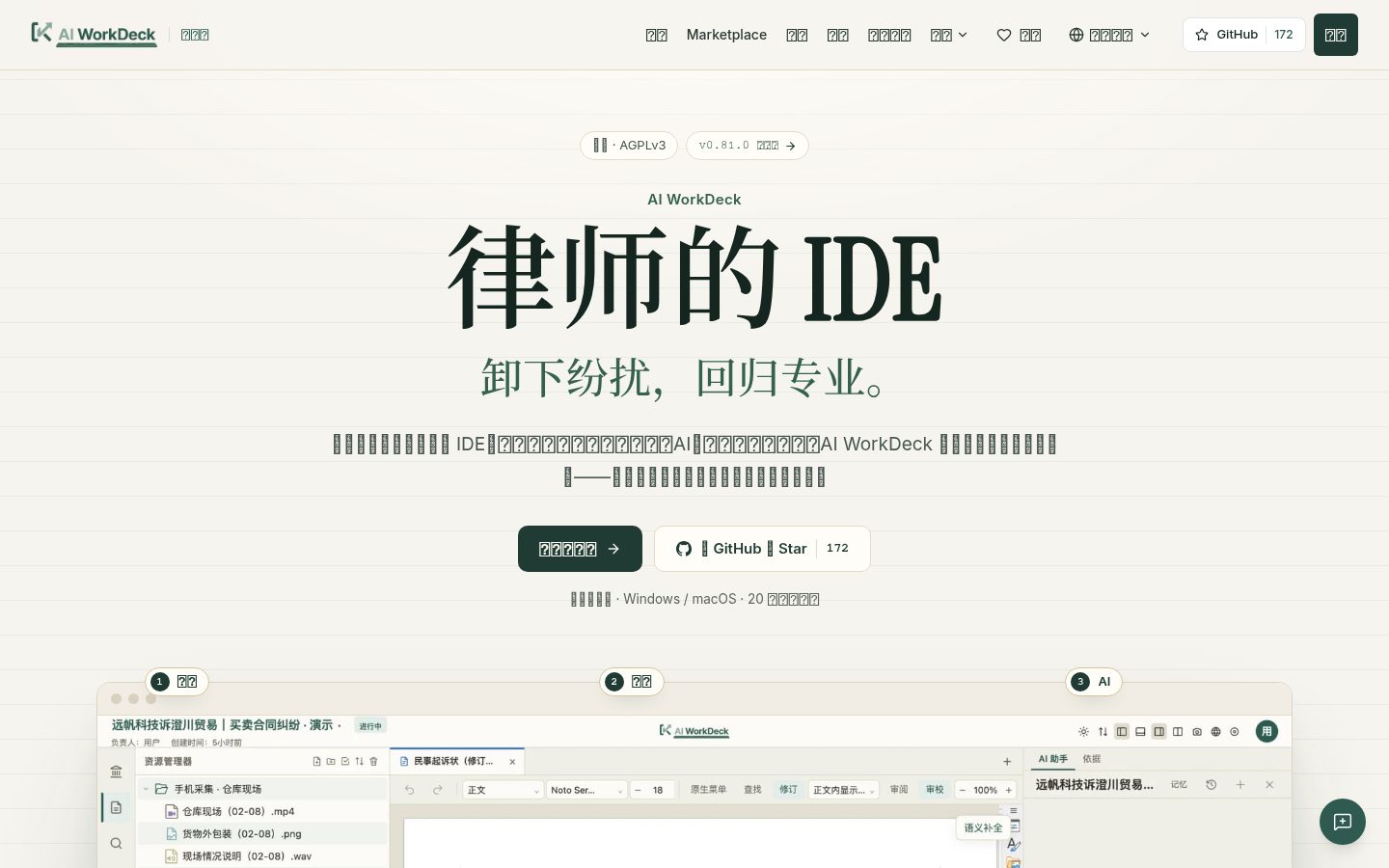
Overview

Programmers have long had their IDE: files, editing, search, versions and AI in one window.
AI WorkDeck brings that infrastructure to lawyers — organised by matter, every answer sourced, every change on the record.






Free community edition · Windows / macOS · English · 简体中文
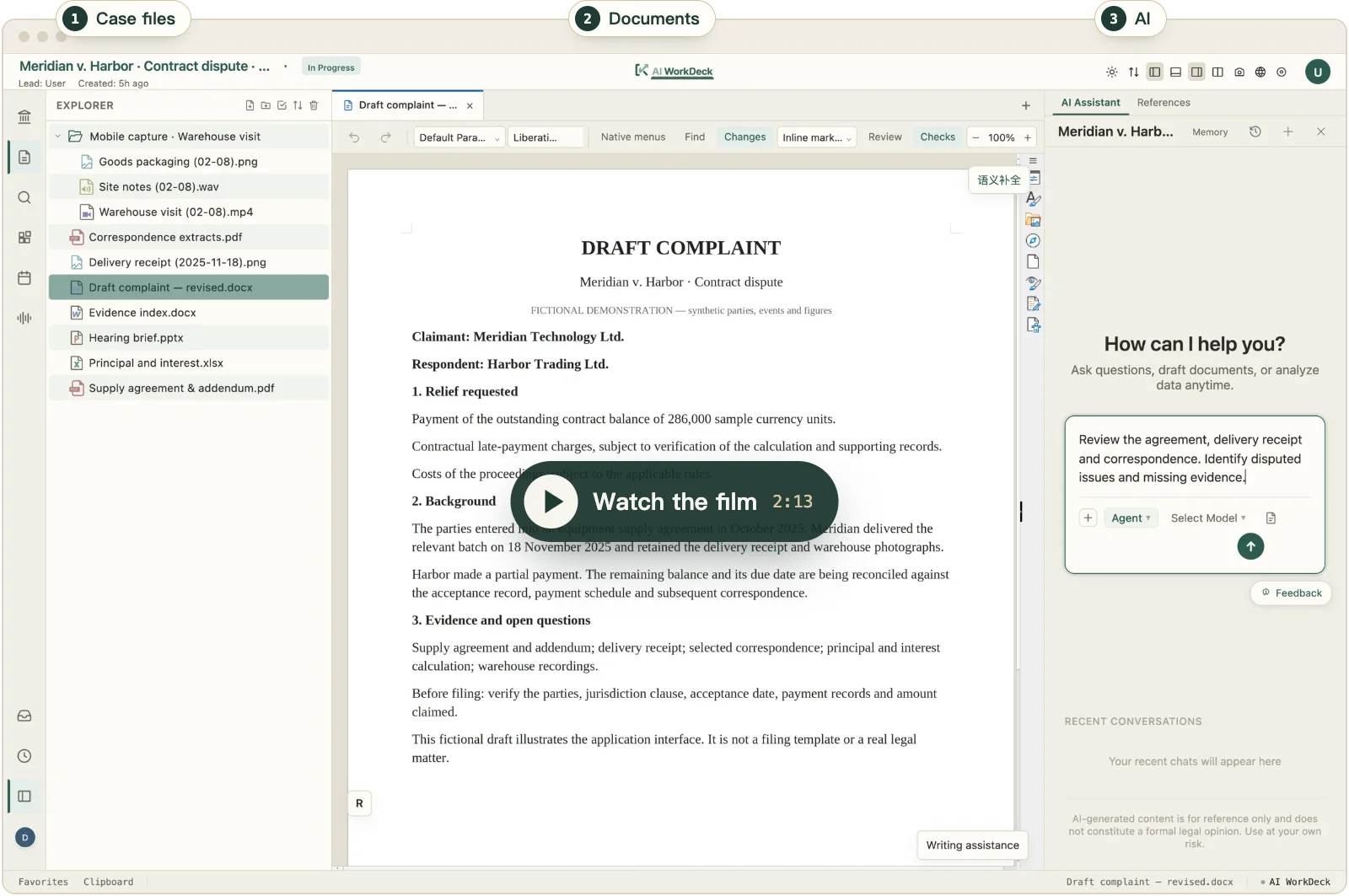
▶ Click the screenshot to watch the 2-minute film. Real interface; the matter is fictional.
Why an IDE
The AI chat box is the command line of the AI era. A big matter means hundreds of documents, months of work and several people. Lawyers, like programmers, work in text — piles of files, draft after draft, citations to check everywhere. They deserve their own infrastructure too.
| Chat box | AI WorkDeck |
|---|---|
| Start from scratch every time | The context lives with the matter |
| Paste the materials in, one by one | The AI reads the case file and edits the documents |
| Copy the answers back out, piece by piece | Every step leaves a record |
Just a quick question? Switch to chat mode. For the longer argument, read our thesis →
What it does
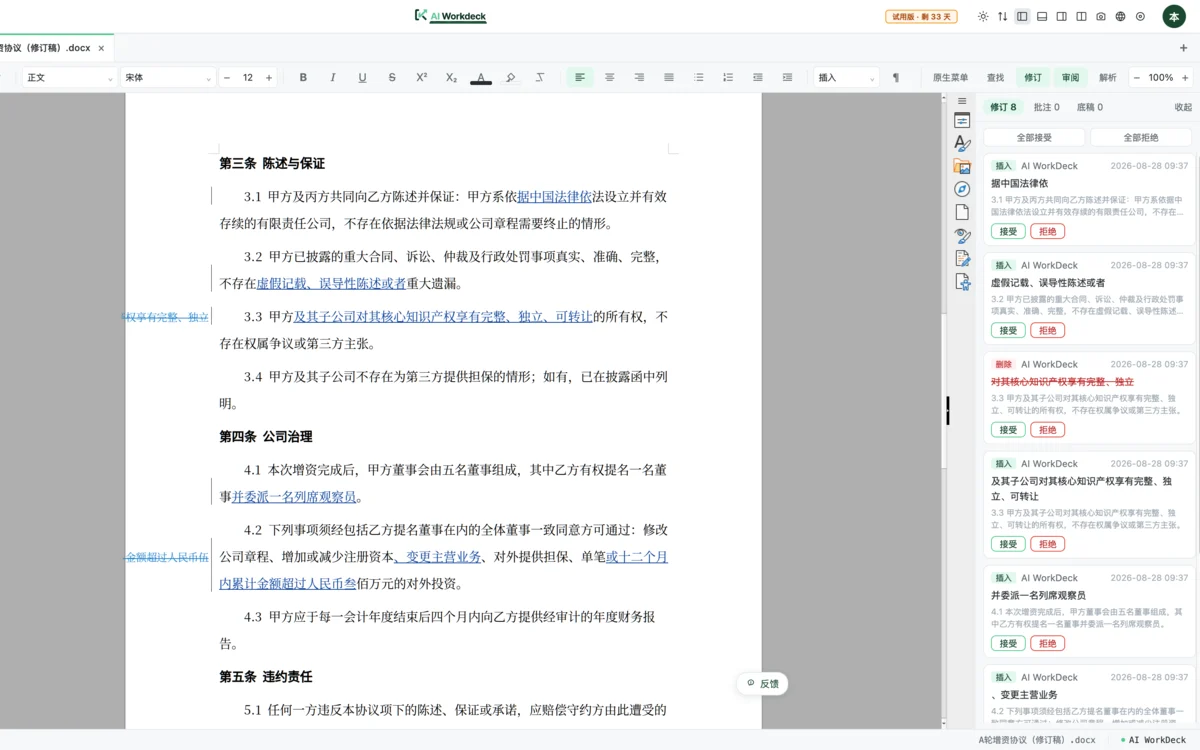
AI edits the document itself. It writes straight into the real Word file as tracked changes, and you accept or reject each one. |
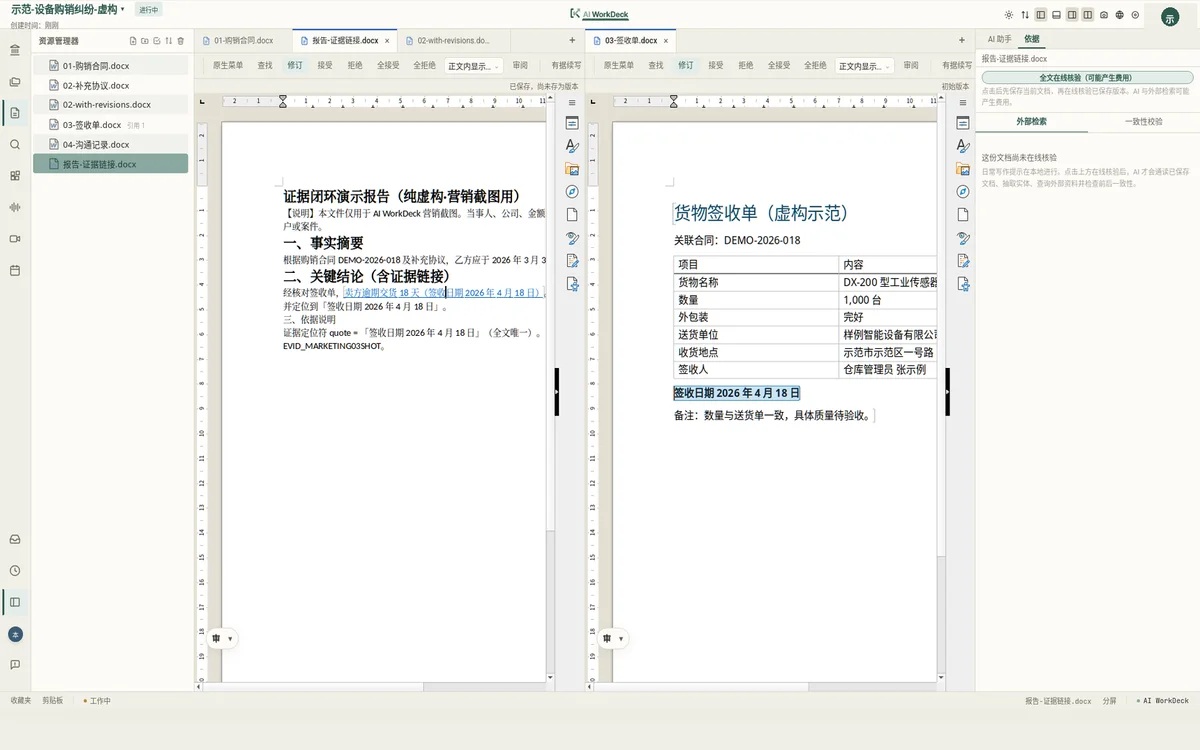
Every conclusion has a source. Click a citation to land on the supporting passage; changed or missing anchors are flagged. |
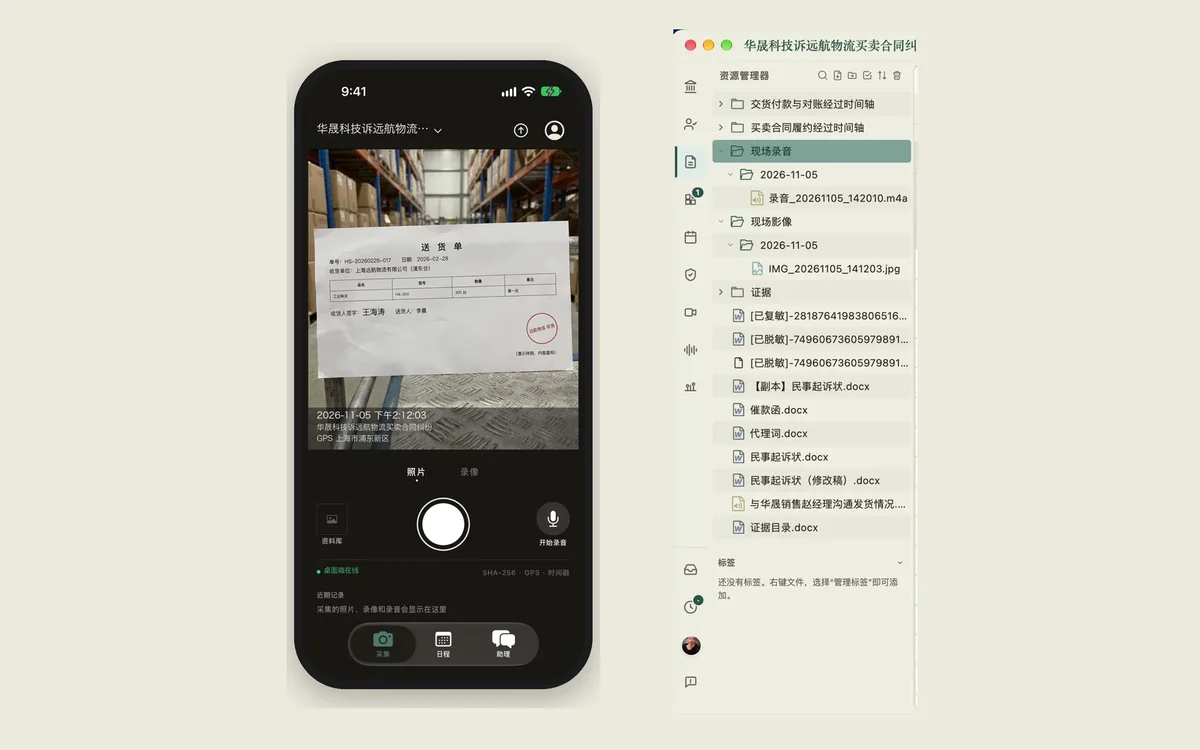
The field and the office, connected. Photos and recordings taken on your phone land in the matter on your computer, filed by date. |
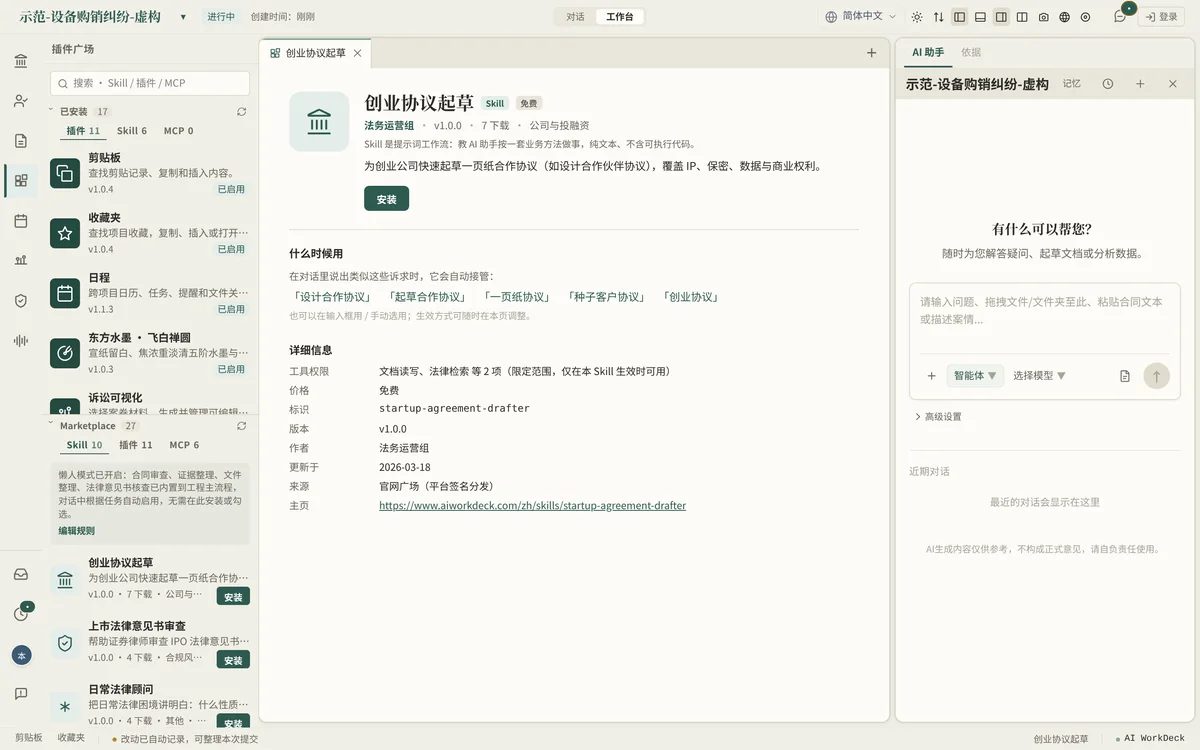
Extended by the community. Install Skills, plugins and MCP servers in one click — or publish your own; authors keep 85% of net receipts on paid listings. |
Screenshots use fictional demo matters. The interface is shown in Chinese; it ships in 20 interface languages.
Video tutorials
Two minutes, one task — 19 short episodes on the website. Tutorials are in Chinese for now.
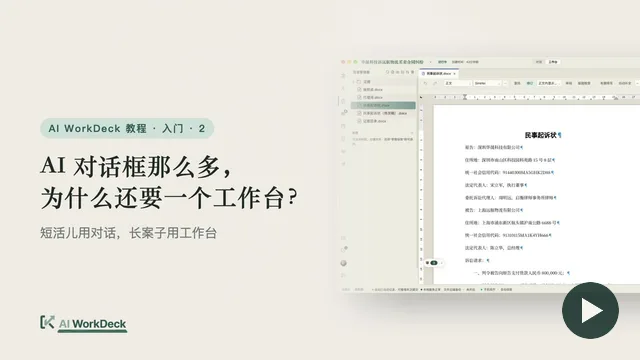 Why a workspace? | 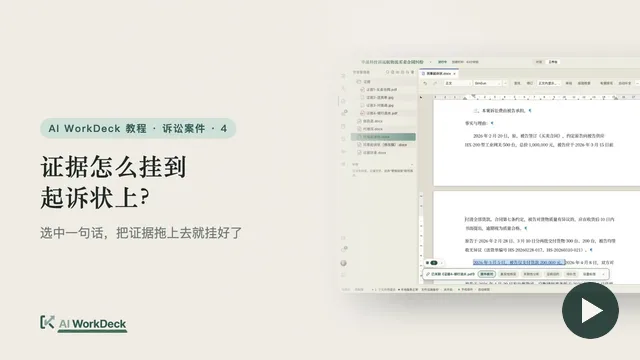 Linking evidence into the complaint | 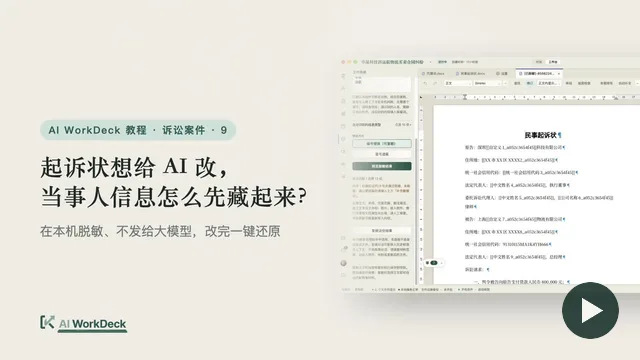 Hiding party details before the AI edits | 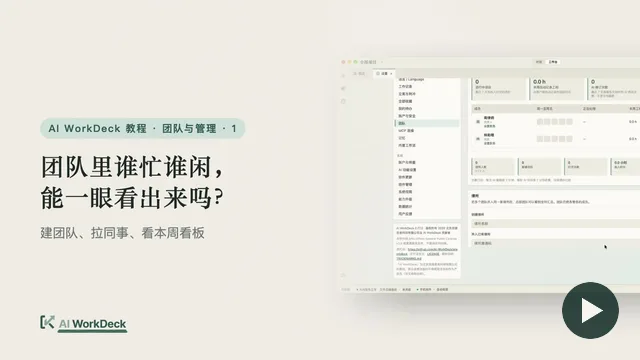 Who on the team is busy? |
Try it
- Use it: macOS / Windows releases · try it in the browser · website.
- Run from source: Getting started · Architecture. The contributor stack uses JDK 21, Maven, Node/npm and PostgreSQL; optional sidecars have additional requirements.
- Know the data paths: desktop editing uses local storage by default; cloud models, platform services, hosted add-ins and sync have different data paths. Self-hosting requires configuration and deployment-specific verification. See Privacy and service data flows.
Build with us
The repository contains the desktop app, workbench, agent backend, document-editor integration and plugin runtime. The foundations map to code you can read:
| Foundation | Where to look |
|---|---|
| Document-native agent edits, tracked changes and checkpoints in the embedded LibreOffice WASM editor | Editor primitives · Editor bridge |
| Source links with anchor-change detection; a pluggable evidence-provider interface | Evidence contract · Provider example |
| Git-backed history, three-way document merge, paragraph-level provenance | Version engine |
| Web panes, Java tools, declarative templates and reusable Skills | Plugin guide · SDK · Skill spec · Examples |
| Built-in workflows and entry points | Skills · Litigation visualization · Desktop · Office/WPS add-in |
Build a plugin. Start with the minimal web plugin (plain HTML and JavaScript, no build step) or the declarative plugin, or let an agent help you through the developer walkthrough. Web plugins run in a sandboxed iframe behind a permission-checked bridge; Java plugins run in the backend process and must be trusted. The developer program initially has no application fee; basic profile review is not identity certification, and each plugin version undergoes separate review and signing. The plugin guide explains the boundaries and the publication process.
Contribute. A small reproducible case is especially valuable: a document that loses formatting, a source link that no longer resolves, an edit that fails to round-trip, or an unclear setup step. Use synthetic or redacted materials, and discuss large changes in an issue first. Read the contribution guide. Code contributions require a one-time CLA; contributors retain copyright and grant the steward dual-licensing rights. Substantial API changes use the RFC process; the governance model, maintainers, and contributor directory are public; merged code contributors and published marketplace authors are named there. Plugin and Skill authors can publish through the marketplace (China · International) under the marketplace terms; funded tasks follow the bounty policy, with availability and amounts set per issue.
Roadmap — contribution directions, not dated release commitments: reliable document work on complex layouts, long documents, tracked changes and undo; source links that survive edits; a shorter path for builders (clean local demo, self-hosting docs, more examples); and repeatable professional workflows packaged as Skills. Bring a use case to Discussions.
About
AI WorkDeck is an open-source exploration rooted in day-to-day legal work, developed outside working hours with team support and feedback from colleagues. Its initiator, Zewei Han, is a practicing lawyer and a partner at Beijing Redsunny Law. He previously worked at King & Wood Mallesons, where he supported projects of the firm’s legal technology team, and co-authored 《大模型时代的法律科技》 (on legal technology in the era of large models). Contact: [email protected].
Licensing and stewardship
The steward is 北京公富信息技术有限公司 (BEIJING GONG FU INFORMATION TECHNOLOGY LIMITED). The same entity operates the domestic and international offerings. Commercial licensing covers the steward's code; third-party components retain their own terms. See AGPL-3.0-or-later, commercial licensing, third-party components, and trademarks.
The steward's existing policy allocates 20% of net commercial-licensing revenue to a community fund for bounties, Skill-creation grants, and community events. This is a public policy that may be adjusted prospectively, not an individual contractual entitlement. Governance roles carry technical authority; economic terms are set separately in the bounty policy and marketplace terms.
For licensing needs outside AGPL, contact [email protected]; the commercial license sets out the applicable terms.