
ai-text-detector
A cautious, explainable AI text detector for local workflows and coding agents. Need production detection in your app? Try the Lynote AI Detector API → lynote.ai/ai-detector-api
Automatically checked · GitHub checked 2026-11-16

Overview
Lynote AI Text Detector
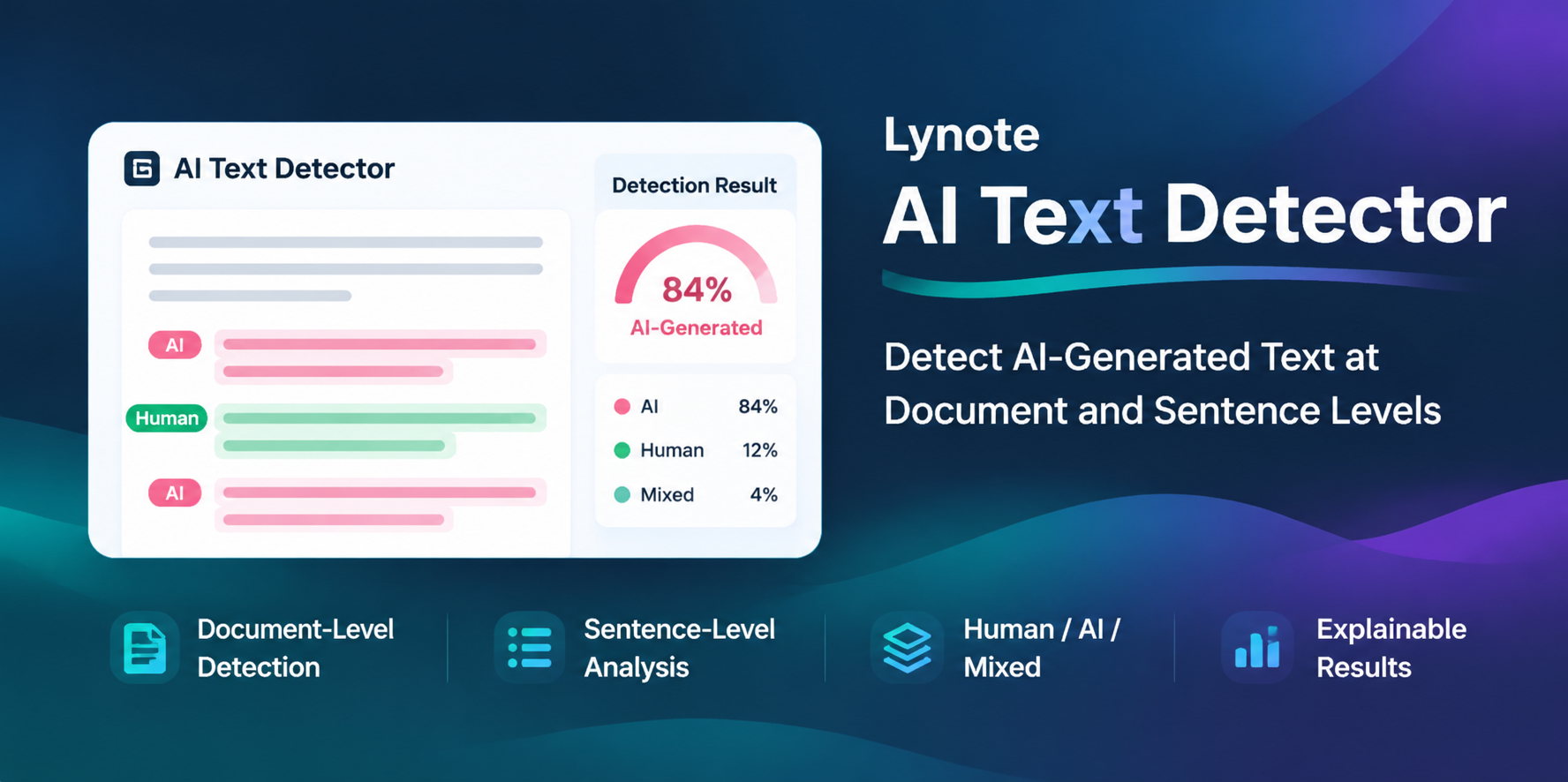


Detect AI-Generated Text at Document and Sentence Levels
Analyze writing patterns, identify potentially AI-generated sentences, and review content classified as human-written, AI-generated, or mixed.
简体中文 · Features · How It Works · Use Cases · Installation
Lynote AI Text Detector is an AI-generated text detection project for analyzing essays, articles, academic writing, notes, transcripts, and other written content. Its production model is designed to examine text at two levels: the overall document and individual sentences.
Rather than treating every document as entirely human-written or entirely AI-generated, the production model supports Human, AI, and Mixed document classifications, alongside sentence-level Human, AI, and Paraphrased classifications.
The repository also includes a separate lightweight local analyzer for explainable, offline text-risk triage. The local analyzer and the production two-level model are different components; their capabilities and evaluation results should not be conflated.
Features
Document-Level AI Text Detection
Analyze a complete document and classify its overall writing patterns. The production model supports:
- Human — classified as human-written.
- AI — classified as AI-generated.
- Mixed — a document containing a combination of writing patterns.
Sentence-Level AI Detection
Go beyond a single document-level result. The production model also classifies individual sentences as:
- Human
- AI
- Paraphrased
Sentence-level results can help reviewers locate sections that warrant closer attention. They should be interpreted as model classifications, not proof of who wrote a sentence.
Mixed-Content Analysis
Real-world writing may combine original human writing, AI-generated passages, and edited or paraphrased material. The production model includes a mixed document class to represent this kind of content rather than forcing every document into a binary human-or-AI label.
Explainable Local Analysis
The lightweight local analyzer returns an AI-like writing risk estimate with supporting information:
- Risk score from 0 to 100.
- Verdict and confidence level.
- Strongest weighted signals.
- Caveats and limitations.
- Suggested next steps when useful.
This local analyzer is intended for cautious preliminary review. It is not the production two-level classifier.
Multilingual Model Development
The production pipeline is designed around multilingual backbones, including XLM-R and ModernBERT, with the current project documentation describing work focused on English, Chinese, Portuguese, and Spanish.
Responsible Interpretation
AI-text detection is inherently uncertain. Results should be treated as indicators for review, not definitive proof of authorship, misconduct, or intent. Short samples and high-stakes decisions require particular caution.
How It Works
The production detection pipeline uses a shared model backbone with two classification heads:
- Document head — predicts a document-level class:
human,ai, ormixed. - Sentence head — predicts sentence-level classes:
human,ai, orparaphrased.
The joint training objective combines document-level and sentence-level learning:
L = L_doc + α · L_sent
flowchart TD
    A[Input document] --> B[Text processing]
    B --> C[Shared model backbone]
    C --> D[Document-level head]
    C --> E[Sentence-level head]
    D --> F[Human / AI / Mixed]
    E --> G[Human / AI / Paraphrased]
    F --> H[Detection output]
    G --> H
    H --> I[Human review and interpretation]
The repository contains both the production model pipeline and a lightweight local analyzer. See the project structure and the technical documentation for the distinction.
Production Model Documentation
Use Cases
Teacher Triage
A teacher receives a student essay or reflection and wants an initial signal before conducting a closer review.
Suggested workflow:
- Run the detector on the submitted text.
- Review the available document-level result and, where supported, sentence-level classifications.
- Consider the result alongside the student's previous writing and other relevant context.
Detection results should never be treated as proof of academic misconduct.
Editorial Review
An editor wants to review articles, product descriptions, guest posts, or other submitted content for writing patterns that may deserve closer attention.
Why it fits:
- Longer-form prose provides more context for review than very short snippets.
- Explainable signals can help editors decide which passages to examine.
- Human editorial judgment remains essential.
Trust and Safety Queueing
A moderation team wants to prioritize suspicious long-form posts for manual review rather than automatically removing content.
Why it fits:
- Detection signals can support review prioritization.
- Document-level and sentence-level results can provide different views of the same text.
- Final moderation decisions remain with human reviewers.
Internal Content Quality Review
A team wants to review human-written and AI-assisted drafts and identify passages that may need additional editing.
Why it fits:
- Detection results can be used as one signal during content review.
- Sentence-level analysis can help locate specific passages for closer examination.
- Results should be interpreted in context, not as definitive authorship claims.
Detection Results: Two Different Components
This repository includes two distinct detection components. Their outputs should not be treated as interchangeable.
Production Two-Level Model
The production pipeline is designed to provide:
| Analysis level | Supported classifications |
|---|---|
| Document | human, ai, mixed |
| Sentence | human, ai, paraphrased |
The pipeline includes data preparation, training, calibration, evaluation, and serving code. The repository documentation does not make a general production-accuracy claim.
Lightweight Local Analyzer
The local analyzer provides a separate risk estimate and evidence signals. Its verdict values are:
insufficient_textlow_ai_likelihoodmixed_or_uncertainhigh_ai_likelihood
Example output:
Conclusion: AI-like signals are present, but this medium-confidence score is a risk estimate rather than proof.

Score: 84/100
Confidence: medium
Verdict: high_ai_likelihood
Words analyzed: 256
The example illustrates the local analyzer's output format; it is not a claim about expected accuracy or production-model output.
Installation
The lightweight local analyzer can be installed and run with Python.
Requirements
- Python 3.9 or later.
Install
git clone https://github.com/lynote-ai/ai-text-detector.git
cd ai-text-detector
pip install -e .
Alternatively, initialize a local environment with:
bash scripts/setup.sh
Run Detection
Analyze a text file:
ai-detect examples/sample_ai_like.txt
Return JSON:
ai-detect examples/sample_ai_like.txt --json
Read text from standard input:
cat essay.txt | ai-detect --json
Python Usage
The lightweight local analyzer can also be called from Python:
from aidetect import analyze_text

with open("essay.txt", encoding="utf-8") as file:
    text = file.read()

result = analyze_text(text)

print("Score:", result.score)
print("Confidence:", result.confidence)
print("Verdict:", result.verdict)

for signal in result.strongest_signals():
    print(signal.name, signal.note)
Evaluation
The repository includes a reproducible evaluation of the lightweight local analyzer using the public HC3 dataset.
The documented evaluation uses the English finance, medicine, and open_qa subsets, taking the first 100 rows from each subset.
Evaluation Snapshot
| Metric | Result |
|---|---|
| Human mean score | 5.4 |
| AI mean score | 18.4 |
| Mean separation | 13.0 points |
| Human coverage | 0.427 |
| AI coverage | 0.920 |
Covered accuracy at score >= 45 | 0.317 |
These results indicate that the local analyzer separates human and AI answers on average in this sample, but its measured covered accuracy is limited. It is better understood as a cautious triage and explanation tool than as a stand-alone authorship classifier.
Scope note: These metrics apply only to the lightweight local analyzer on the documented HC3 sample. They are not benchmark results for the production two-level model.
Read the full HC3 evaluation report.
Reproduce the evaluation:
make eval-hc3
Project Structure
ai-text-detector/
├── detection-model-pipeline/   # Production two-level model pipeline
│   ├── code/                   # Pipeline stages and validators
│   ├── model_entity/           # Model components and backbones
│   ├── data/demos/             # Synthetic demo data
│   └── docs/                   # Model and pipeline documentation
├── assets/                     # Project images and diagrams
├── docs/                       # Evaluation reports
├── examples/                   # Example input text
├── references/                 # Reference documentation
├── scripts/                    # Local detection and evaluation scripts
├── src/aidetect/               # Lightweight local analyzer
├── tests/                      # Tests
├── AGENTS.md
├── SKILL.md
├── README.md
├── README.zh-CN.md
├── pyproject.toml
└── requirements.txt
Developer Integration
The primary focus of this project is AI-generated text detection. For local use, the repository provides a CLI and Python interface through the lightweight analyzer.
For hosted integration into another application, see the optional Lynote AI Detector API. API access is an additional integration option, not the central purpose of this repository.
Technical references:
Development
Run the test suite:
make test
Run the demo:
make demo
Run the benchmark:
make benchmark
Run the HC3 evaluation:
make eval-hc3
Continuous Integration
GitHub Actions is configured to run tests on Python 3.9, 3.11, and 3.13, regenerate benchmark and HC3 evaluation reports, and upload the reports as workflow artifacts.
Contributing
Contributions are welcome. Useful areas include:
- Document-level and sentence-level detection.
- Multilingual detection.
- Explainable detection signals.
- Evaluation methodology and benchmark coverage.
- Responsible interpretation and safer user guidance.
See CONTRIBUTING.md for contribution guidelines.
Related Projects
License
MIT. See LICENSE for details.
Lynote AI Text Detector
AI-generated text detection at document and sentence levels.