#1
An open-source, self-hostable PaaS alternative to Vercel, Heroku & Netlify that lets you easily deploy static sites, databases, full-stack applications and 360+ one-click services on your own servers.
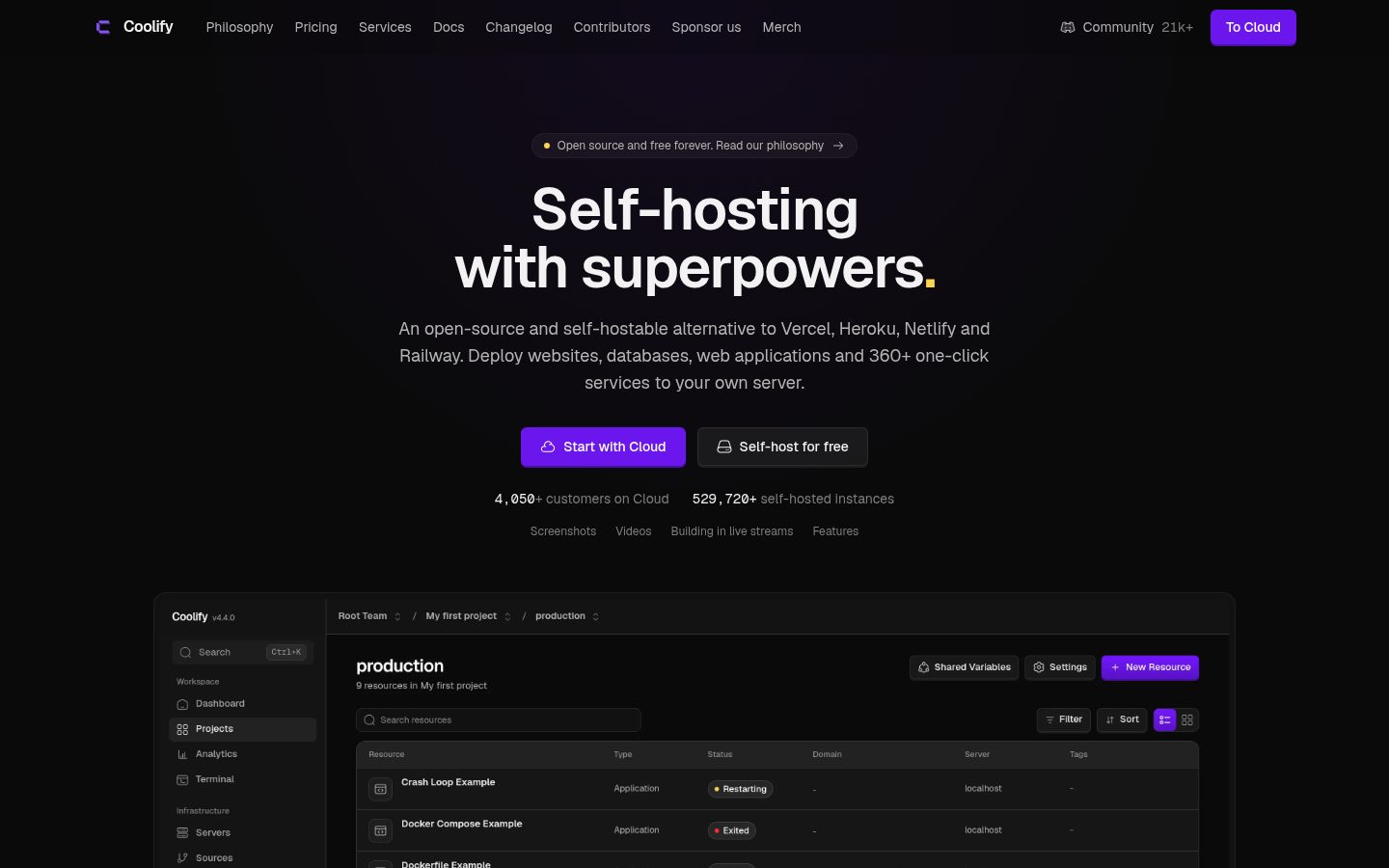
An open-source platform to deploy applications, databases, and services on your own servers.
Coolify is an open-source and self-hostable alternative to Heroku, Netlify, and Vercel. It helps you manage servers, applications, and databases on your own hardware. You only need an SSH connection.
You can use a VPS, a bare-metal server, a Raspberry Pi, or any other server that accepts SSH connections. Coolify gives you the convenience of a cloud platform while you keep control of your infrastructure.
Your configurations stay on your servers. If you stop using Coolify, your running resources continue to work and remain manageable.
- Deploy any application: Build from GitHub, GitLab, Bitbucket, or Gitea with Nixpacks, Railpack, Dockerfile, Docker Compose, or a prebuilt Docker image.
- Run databases and services: Deploy managed databases and more than 360 one-click services with persistent storage and generated credentials.
- Automate deployments: Deploy on every Git push, create pull-request previews, call deployment webhooks, and roll back to retained application images.
- Manage networking: Configure custom domains, automatic HTTPS certificates, reverse proxies, health checks, and container networks.
- Operate your infrastructure: Manage multiple servers, inspect deployment and runtime logs, open container terminals, and monitor resource status.
- Protect your workloads: Configure database and storage backups, scheduled tasks, environment variables, secrets, and notifications.
- Integrate with your workflow: Manage resources through the dashboard, API, CLI, MCP, and team-based access controls.
The recommended self-hosted setup uses one server for Coolify and one or more servers for deployed resources. If you do not want to maintain the Coolify server, use Coolify Cloud. See coolify.io for current pricing.
License: Apache-2.0
#2
Open-source, self-hostable alternative to Vercel, Netlify, Railway and Heroku. Self-host any app on your own servers in minutes.
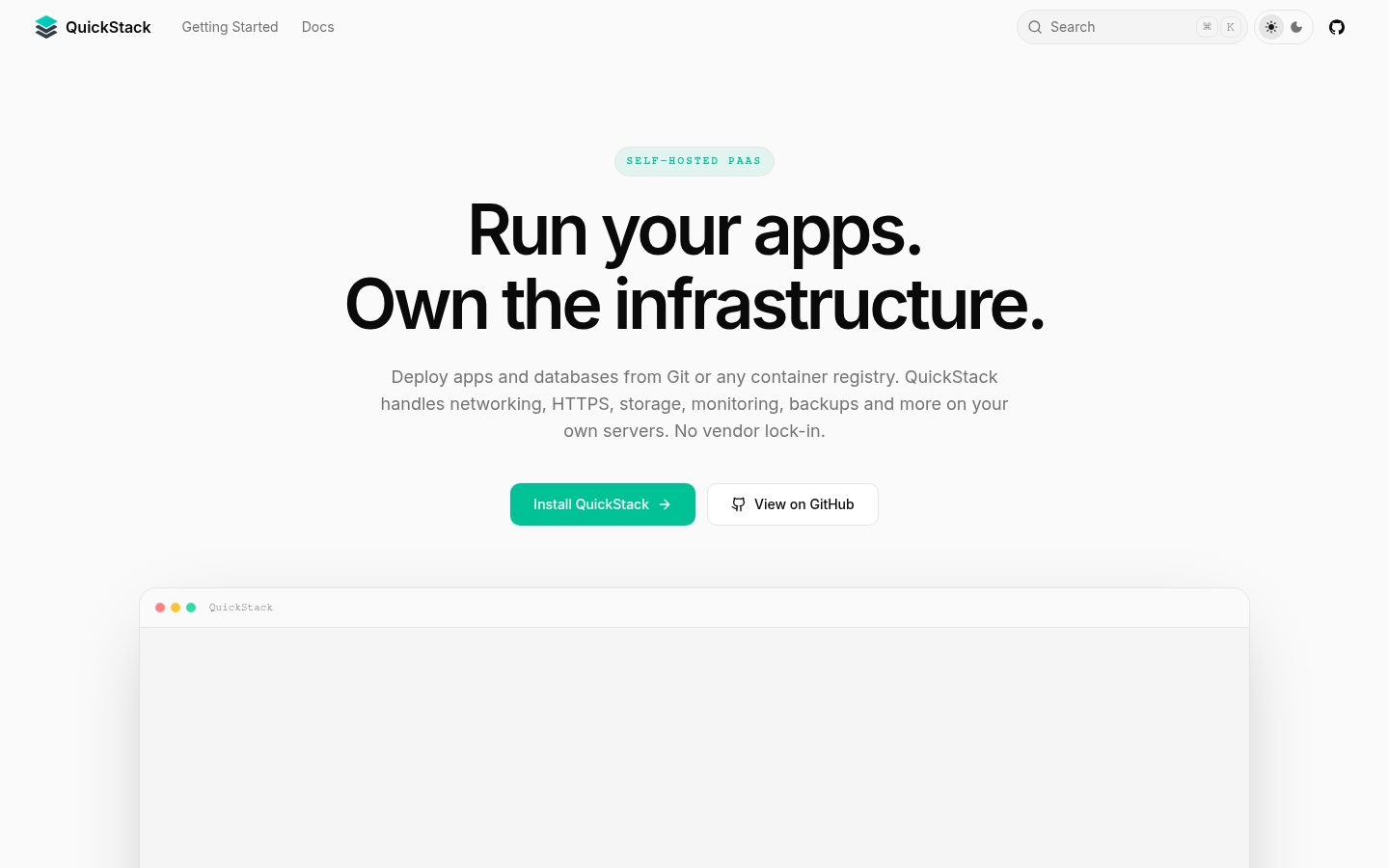
Free, open-source, self-hosted PaaS alternative to Vercel, Netlify, Railway and Heroku.
Deploy and manage applications and databases on your own VPS, Bare Metal or any other infrastructure through a clean web interface. QuickStack combines the simplicity and scalability of modern cloud platforms with the control of self-hosting.
- Flexible deployments: Deploy from public or private Git repos and registries using Railpack, guided framework builds, or your own Dockerfile.
- Framework builds: Deploy Next.js, React, Angular, Nuxt, Astro, and SvelteKit with preconfigured build commands, output paths, and ports—then adjust them when your project needs it.
- Project Canvas: Manage each project's Apps, databases, network connections, configuration, builds, logs, backups, and lifecycle actions from one visual workspace.
- One-click apps and databases: Launch popular apps, PostgreSQL, MySQL, MariaDB, MongoDB, and Redis in seconds.
- Runtime controls: Scale replicas, set CPU and memory resources, and configure health checks, environment variables, Dockerfile build arguments, and file mounts.
- Multi-server support: Add nodes and keep persistent data on replicated Longhorn volumes.
- Secure networking: Isolate apps by default and add unlimited custom domains with automatic Let's Encrypt SSL.
- Monitoring: Stream logs and monitor CPU, RAM, storage, and health in real time.
- Backups you control: Schedule volume backups to S3-compatible storage, optionally run them before deployments, and create native database dumps.
- Team-ready access: Control project and app access with user groups, roles, OIDC SSO, 2FA, and expiring API keys.
- Automation and rollbacks: Deploy via webhook or REST API and roll back to a previous version in one click.
- MCP integration (canary): Expose read-only or read-write Model Context Protocol access to compatible AI clients, with secret fields redacted by default.
- Self-hosted and open source: Install with one command, update from the UI, and avoid lock-in with GPL-3.0 source code.
QuickStack was originally developed as a student project by glueh-wyy-huet and biersoeckli at the Eastern Switzerland University of Applied Sciences. Since then, new features have been added to make QuickStack a powerful and user-friendly platform for self-hosting.
- biersoeckli/QuickStack-Docs: The official documentation for QuickStack, including tutorials, guides and API references.
License: GPL-3.0